


Charles Anthony Clark Milwaukee Real Estate Investor Insights
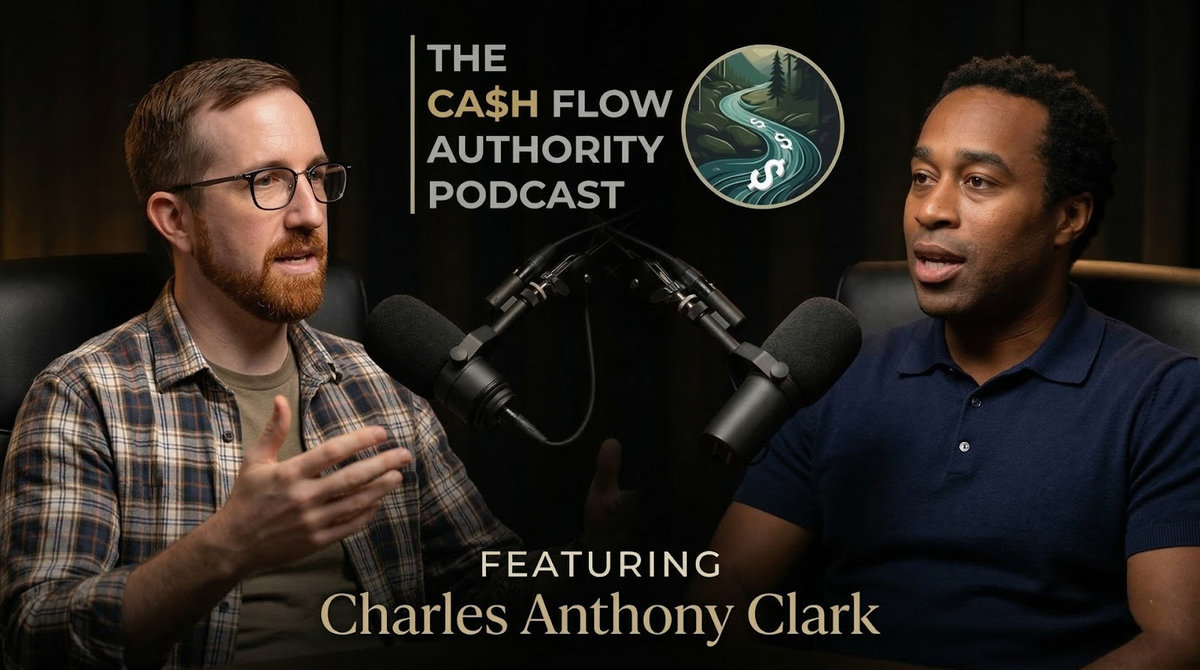
Carlton Sheets infomercials. That's where it started for Charles Anthony Clark, and when he told me that on a recent episode of the Cash Flow Authority Podcast, I had to smile. Those late-night TV pitches about buying houses with no money down planted a seed in an 18-year-old who decided early that nobody was going to hand him anything, so he'd go out and get it himself.
I sat down with Charles to talk about what Milwaukee real estate investor life actually looks like when you're building a team, serving out-of-state clients, and refusing to lower your standards for a quick commission. He runs Raise the Standard Real Estate with NextHome My Way, and the way he operates, whether he's walking an out-of-state investor through a five-unit deal or volunteering to teach financial literacy to teenagers, tells you everything about where his priorities sit.
A handful of clips from this one are worth the detour. Give them a look.
If you want the full hour, every detour into Milwaukee zip codes, out-of-state investor playbooks, and the philosophy behind walking away from a commission that doesn't serve all four parties, the whole conversation is right here.
We bring people like Charles on the show because they're building something worth paying attention to. Stay connected with his team on Instagram and follow Charles on LinkedIn for more of what Midwest investing actually looks like from the ground.
Introduction to Charles Anthony Clark
Charles is the Broker Team Leader at Raise the Standard Real Estate with NextHome My Way, and a recipient of the Lloyd Levin Difference Maker Individual Award for volunteering to teach financial literacy to teens. That award tells you how he approaches the business: every client interaction is a teaching moment, whether the client is a teenager learning about compound interest or a California investor trying to underwrite a five-unit in one of Milwaukee's most overlooked zip codes.
Our conversation covered the neighborhoods most agents write off, the depreciation math that makes Wisconsin properties outperform on a tax return, and the systems Charles builds for remote investors who need more than a listing alert.
Why Midwest Markets Like Milwaukee Offer Strong Cash Flow
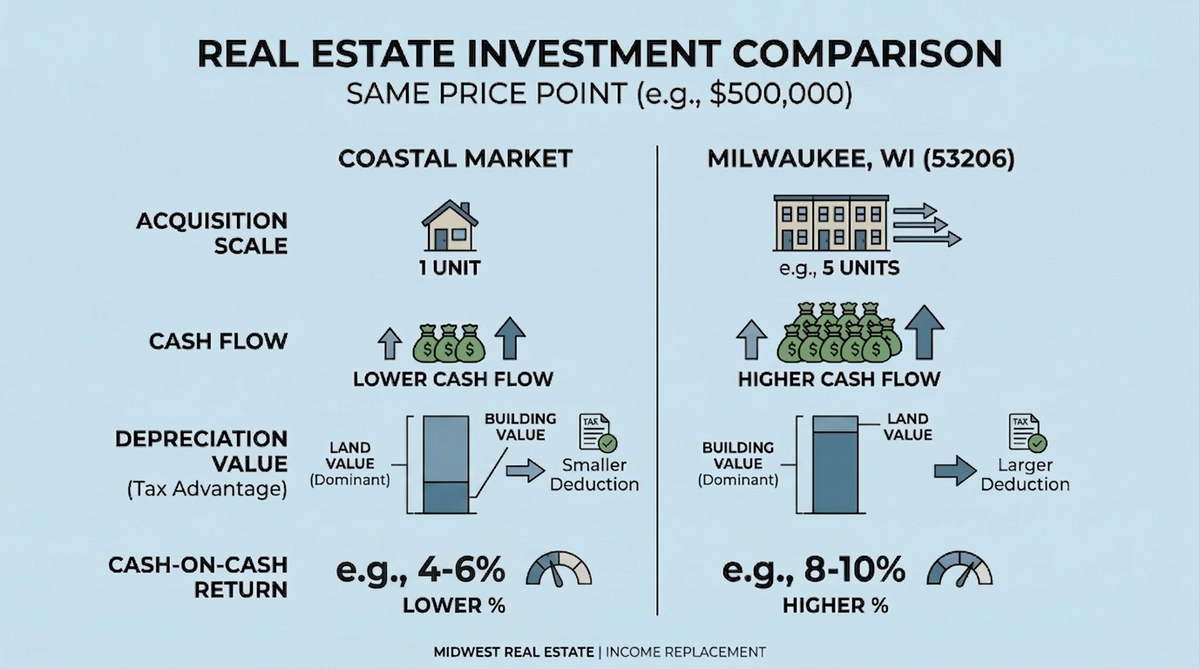
I own a five-unit in Milwaukee, zip code 53206, and the cash flow from that property outperforms anything I've come across in coastal markets on a dollar-for-dollar basis. Midwest cash flow real estate is where the math works for investors who want to replace income, not just park capital.
Here's what draws serious investors to these markets:
Lower acquisition costs: Properties that run $500K+ on the coasts go for a fraction of that price in Milwaukee
Strong rent-to-price ratios: Monthly rents relative to purchase price produce positive cash flow from day one
Superior depreciation: In Wisconsin, you can depreciate 80% to 90% of your investment since building value dominates land value
Consistent tenant demand: Working-class rental housing stays occupied year-round
The depreciation piece is one most investors overlook until they see the numbers. The IRS allows residential rental property owners towrite off their buildings over 27.5 years, and that deduction hits substantially harder when the building-to-land ratio favors the structure. In California, land eats most of the purchase price. In Wisconsin, the building carries the weight, and that changes the entire return profile.
Milwaukee Real Estate Investing Opportunities
Charles didn't sugarcoat the Milwaukee market during our conversation. He went straight at the neighborhoods most investors write off, and made a case I've been thinking about ever since.
"That area has a bad reputation because of a documentary, but we need individuals like you investing there. Those individuals need good homes. People say 'don't invest there,' but that's where the opportunities are. That's where you find $100,000 houses. If you buy and improve four of them, you're helping the neighborhood. Bayview wasn't always 'Bayview'; it was a neighborhood people ignored until investors came in."
He called it the "Tesla effect." If you want the 10x return, you go where others aren't going. Wauwatosa and Waukesha are the blue chips, and the margins reflect it. The overlooked zip codes are where value-add investors can move the needle on both returns and community impact. Recent economic data backs this up: Wisconsin and the Milwaukee metro area are outperforming national averages on employment and home price growth, giving long-term investors another reason to pay attention to Milwaukee rental property investing.
Helping Out-of-State Investors Buy Rental Property in Milwaukee
I told Charles that one of my biggest frustrations as a remote investor is feeling like I'm burdening my local team by asking them to look at deal after deal. His response cut through that immediately.
"You might be working with the wrong team. I use a Google Drive for my clients where I upload walk-through videos of properties so they can see them whenever they want. I like looking at properties anyway because it keeps me informed on the market. If an agent feels burdened, they aren't treating it like the business it is. I even leverage other agents by giving them a percentage of the deal to help with showings. I don't need the whole grape; I just need a piece of the watermelon."
That last line stuck with me. Charles treats his brokerage like a consulting operation, and he'd rather give a slice of a deal to another agent than miss an opportunity for his client. This is what separates a Milwaukee real estate agent for investors from someone who holds a license and waits for referrals.
Key members of a strong out-of-state investor team:
Investment-focused real estate agent
Licensed contractor with rehab experience
Local lender or financing partner
Property management support (even ad hoc)
Deal analysis and market data expertise
If you're building a plan to buy rental property in Milwaukee, Wisconsin from out of state, assembling this kind of team is where it starts. Our 90-Day Cash Flow Accelerator breaks down exactly how to secure your first deal.
Charles Anthony Clark's Raise the Standard Philosophy
Charles operates by three models, and the first one gives his brokerage team its name. He laid all three out during our conversation, and they're worth hearing in full.
"Raise the Standard means that if a deal doesn't work for me, my family, my client, and the community, I don't want to do it. I won't lower my standards for a quick buck. I once walked away from a client who asked me to lower my commission after I helped him find a fix-and-flip and a contractor. It wasn't a win-win."
"The second model is 'Be better by being better,' which I learned as a high school quarterback. It's about 1% improvement every day. The last one is 'What's your legacy?' We aren't going to be here forever, so are you leaving things better than you found them? Even if I leave a place not on the greatest terms, I know I left systems in place that made it better."
I've seen the math on the 1% principle: improving by that margin daily nearly quadruples your output over a year. Charles has internalized it, and it shows in how he runs his team.
Turning Real Estate Investing Into a Business
The line between a hobbyist and a real investor comes down to systems. Charles sees that gap constantly with his clients, and his approach to closing it is completely hands-on.
"I tell my out-of-state clients I'd rather assist them than take a 10% margin that hurts their bottom line. Once you hit 25 units, you need a part-time person because you'll have three to five issues a week. But for one to ten units, I just help them out. I'll find the tenants, run the numbers, and help them set up systems like DoorLoop or even just a separate Gmail and Google Voice number."
"I try to help my clients build a business, not a hobby. My commission is earned after we close because my goal is to help you get your next property and build a million-dollar portfolio, not just bug you for referrals."
That last sentence tells you everything about how Charles operates. The commission isn't the finish line; it's the starting point. He's helping clients build the operational infrastructure (tenant screening, communication tools, financial tracking) so their portfolios can actually scale. If you're making the shift from casual investor to portfolio operator, our coaching and wealth-building services are built for exactly that transition.
Appreciation vs Inflation in Real Estate
I asked Charles how he explains appreciation to investors, and his answer was one of the most memorable moments in our conversation.
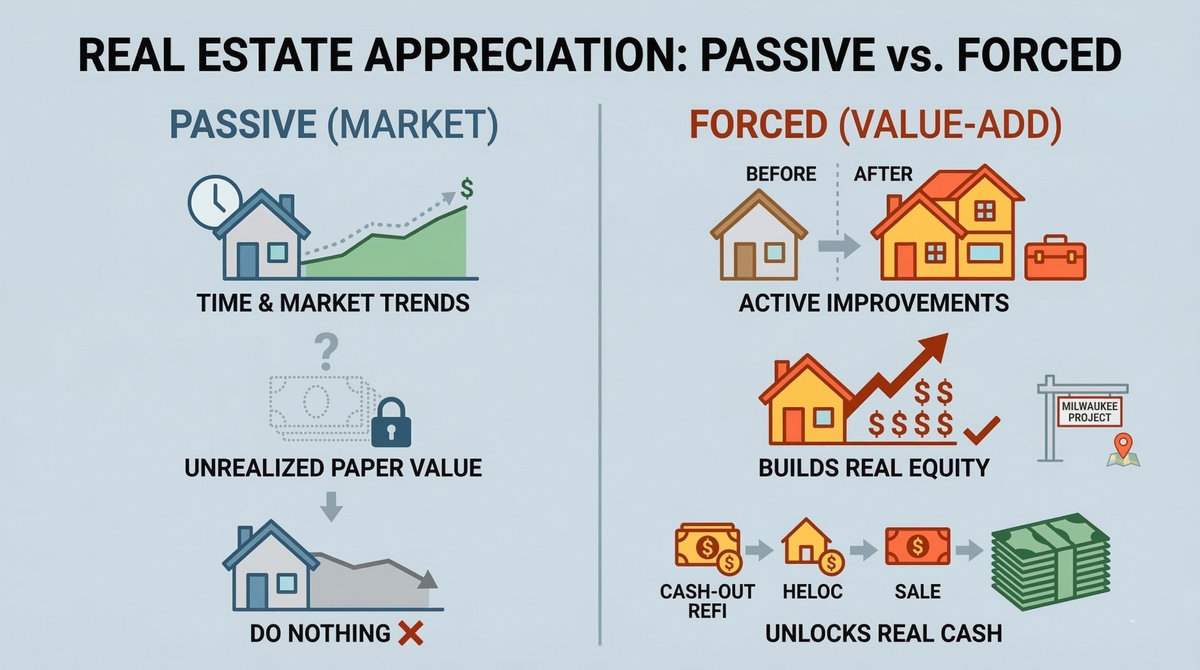
"I'll simplify it. If a farmer sells eggs for $2 and then $3, the buyer calls it inflation, but the farmer calls it appreciation because he has more money. It depends on who is buying and who is selling. Appreciation is 'paper money' until you use a HELOC or a cash-out refi to leverage it. That's why I love real estate. It's harder for it to drop overnight like a stock does when Elon Musk smokes on a podcast."
That analogy is deceptively simple, but it captures something most investors miss. Appreciation means nothing until you convert it through a refinance, a HELOC, or a sale. Charles made another point worth sitting with: if you buy a $50,000 property and do nothing to it while tenants cycle through, it might be worth less in three years. Forced appreciation through improvements is what separates passive owners from investors who build real equity.
Why Milwaukee Attracts Investors Nationwide
The data confirms what Charles Anthony Clark, Milwaukee real estate investor and broker team leader, sees on the ground every day.
"Overall, Milwaukee is on the map. About 40% to 50% of my clientele are out-of-state investors from California, Texas, and New York. They know $500,000 gets you a shack in their state, but a multi-unit building in the Midwest. Technology is moving here too. Foxconn, Amazon, and Microsoft are building campuses here. We're only an hour and a half from Chicago, so companies get the talent without the Illinois taxes."
Milwaukee's median listing price sits well below the national median, meaning investors can acquire multi-unit buildings for what a single-family home costs in most coastal cities. Corporate expansion from Amazon and Microsoft adds jobs, fuels tenant demand, and reinforces long-term price support across the metro. The Chicago proximity matters too: Wisconsin offers employers a deep Midwestern talent pool without the Illinois tax burden, and that corporate migration filters directly into housing demand. If you want to understand how discipline and structure translate into real estate returns, the pipeline from corporate growth to rental demand is the engine.
Building a Rental Property Portfolio
Charles Anthony Clark is a Milwaukee real estate investor who understands that portfolio building requires flexibility. He illustrated this with a real client story. He had an investor from San Francisco who came in wanting a fix-and-flip. The market shifted, so they pivoted.
"We added a half-bath, and instead of selling, he rented it for $2,200. It appraised for $249,000, and he pulled his cash out while maintaining a 30% cash-on-cash return. You have to be adjustable. Money isn't real; it's a tool. Use a duplex to pay for your new car or your vacations. Use flips to build capital for apartment complexes."
The practical path starts with a duplex or small multifamily, targets Midwest cash flow real estate where the numbers pencil, and reinvests rental income into the next acquisition. Every deal feeds the next one when you treat the portfolio like a business. My own journey from zero to 13 units followed that same principle: start small, build systems, and let cash flow compound over time.
Frequently Asked Questions
Who is Charles Anthony Clark?
Charles Anthony Clark is a Milwaukee real estate professional and Broker Team Leader at Raise the Standard Real Estate with NextHome My Way. He specializes in helping investors purchase rental properties in Midwest cash flow markets.
Why do investors buy rental properties in Milwaukee?
Milwaukee offers strong rent-to-price ratios, affordable property prices, and growing demand from investors seeking cash flow. Depreciation benefits are also significantly stronger in the Midwest than in high-cost coastal markets.
Can out-of-state investors buy property in Milwaukee?
Yes. Many investors purchase Milwaukee rental properties remotely by building a local team that includes a real estate agent, contractors, and lenders who understand the market.
What is the biggest mistake real estate investors make?
Treating real estate like a hobby instead of building systems and processes to run it like a business. Charles Anthony Clark, Milwaukee real estate investor and broker team leader, sees this constantly and works directly with clients to close the gap through hands-on consulting.
Apply to Be a Guest on the Cash Flow Authority Podcast
The gap between a real estate hobby and a million dollar business is built on systems and a refusal to lower the standard. We are looking for the investors and professionals who are finding the Tesla effect in overlooked markets like Milwaukee. If you are mastering high cash flow returns or building the operational infrastructure to support out of state portfolios, your story belongs here. Join us to discuss how you are raising the standard for the next generation of investors.
Disclaimer: The Flow Authority makes no promise or guarantee of any results, money, success, or lifestyle from learning real estate investing strategies. The information provided in this blog is for educational and informational purposes only and should not be considered financial, legal, or professional advice. The views expressed in this blog are those of the author and do not necessarily reflect the official policies or positions of any organization, government agency, or financial institution. Any personal experiences shared are for illustrative purposes only and may not apply to every person's situation. This information is general, not personal. Seek specific advice from a licensed professional for legal, financial, and business decisions. There are no typical results in real estate investing; every person, property, and transaction is unique. The information shared in this blog is believed to be truthful, accurate, legal, moral, and ethical, and is subject to change.