


Devan Dorzok on Commercial Real Estate Investing in Milwaukee

Devan Dorzok joined the Marine Corps at 17 with no financial education and no concept of building wealth outside a paycheck. A few years later, after discovering Robert Kiyosaki’s Rich Dad Poor Dad, he was negotiating seller financing on a 96-unit apartment building in Wisconsin.
I brought Devan on the Cash Flow Authority podcast because his path from military intelligence to associate advisor at NAI Pfefferle proves that commercial real estate investing in Milwaukee doesn’t require a trust fund, just discipline, creative deal structures, and a willingness to chase opportunities most beginners won’t touch.
Devan’s conviction came through immediately. Real estate is a business, and treating it like a hobby will cost you. He’s six months into brokerage, already working hotel deals and large portfolio complexes, and rebuilding that 96-unit deal with a new partner. For beginners exploring real estate investing or trying to break into commercial without deep pockets, this conversation lays it out.
For the full conversation on military discipline, seller financing, and the Milwaukee market, the whole episode is right here.
Devan is an example of the kind of practitioner I love to interview for the Cash Flow Authority.
Follow along with our community and catch more conversations like this one on Facebook, Instagram, LinkedIn, and X. You can also connect with Devan directly on Facebook.
From the Marines to Multimillion-Dollar Deals — Devan Dorzok’s Origin Story

Devan spent nearly six years in Marine Corps intelligence, separated with discipline and drive but no financial playbook, and picked up Rich Dad Poor Dad about six months after getting out. That single book changed his trajectory.
“Many people know Robert Kiyosaki. He was the one who sparked my initial interest in real estate investing and understanding how it could build wealth beyond just working a job. Growing up, I never really learned about financials or how to make money work for you.”
“Being my first exposure to it, it made real estate really interesting and attractive. I immediately jumped in and made the rookie mistake of buying a property. I used my VA loan and bought a triplex and lucked out, the tenants worked out well, but it made me realize very quickly that I had no idea what I was doing.”
That triplex was his wake-up call. He spent the next three and a half years studying books, podcasts, and material from Kiyosaki and Grant Cardone, deliberately building his sophistication before making his next move.
Why He Went Big — Chasing a 96-Unit Deal with No Millions in the Bank
The triplex taught Devan a painful lesson about scale. When a single tenant leaves a three-unit property, you lose a third of your income overnight. That exposure pushed him toward commercial.
“What led me to commercial real estate was realizing through the triplex experience how painful it is when a tenant leaves and you lose that income. I figured if I’m going to spend a lot of time, energy, effort, and money on investments, why not just go big? After my long stint of self-education, I went after a 96-unit apartment building. I got it under contract and worked with the sellers on seller financing. It ended up falling through, but it was an invaluable lesson that you don’t need millions of dollars in the bank to have access to larger properties if you’re creative about it.”
That deal brought Devan Dorzok into commercial real estate in Milwaukee, connecting him with Wally Saathoff at NAI Pfefferle through a CARW networking event. Six months into the firm, he’s working on hotels, large portfolio complexes, and reviving that 96-unit deal with a new partner. For beginners exploring real estate investing with no money, creative deal structures and the right relationships will take you further than a loaded bank account.
What I Learned Working with Devan Through the Cashflow Accelerator
Devan was a client of mine through the Cashflow Accelerator before he transitioned into commercial brokerage. We originally connected at 10X Real Estate events in Scottsdale, which is where several of my current clients first got plugged in.
The difference he described between large-scale guru programs and hands-on coaching is something I hear from nearly every client. The big programs deliver the vision at scale, but the access stops at the stage door. Coaching built on direct engagement lets you keep asking questions and continue your education at a personal level. That compounds into better deals and fewer expensive mistakes.
What the Marine Corps Taught Us About Real Estate Investing
Devan and I are both Marines. We didn’t serve together, but the imprint is the same. I asked him how military training translates into business, and his answer went straight to something most people get wrong about military culture. Failure is the training method.
“My biggest takeaway from the Marine Corps would be the ability to discipline myself. A lot of what they teach is centered around discipline, self-efficacy, and building yourself up while building up the people around you. That helps in having the drive, the natural curiosity, and the willingness to try things that might fail, because they teach you that it’s okay to fail, as long as you fail quick, fail right, and keep trying. Eventually, you succeed and get better, and then you can teach those who follow you how to do it the right way the first time. I think that’s played a huge role in my first year of brokering being semi-successful already and in pursuing larger deals as an investor.”
I got out in 2012 and had to rebuild that discipline on my own. In the Corps, it’s imposed externally through rank and structure. On the outside, you have to create the systems yourself. That’s the real transition every veteran entrepreneur faces. You replace external accountability with internal structure.
Real Estate Is a Business — Here’s Why That Changes Everything
I asked Devan to define what it actually means to treat real estate like a business. He has a business management degree, and he put it to work.
“It is a business. It’s just a business that involves a house. It’s no different than a retail business, an office building, or a manufacturer; you’re just selling a different product. You’re selling the service of a roof over somebody’s head.”
“When you think about investing in real estate, you’re investing in a business. You’re buying cash flow. You’re spending money to make money. If you can’t look at it like that, it’s going to burn you, whether today, tomorrow, or eventually.”
Income, expenses, operating procedures, contracts, leases, legal structure, incorporation. All of it applies. Business owners who transition from traditional commerce or manufacturing often find their skills transfer directly into real estate. The product is different, but the underlying business fundamentals carry over intact.
Residential vs. Commercial Real Estate — What Every Investor Needs to Know
Stepping into multifamily real estate investing from the residential side can feel like a new sport. Devan broke it down by the metrics that determine whether a commercial deal works.
Triple-net leases shift property taxes, insurance, and maintenance costs to the tenant, giving investors more predictable cash flow with less management burden. Lease structures and commercial deal evaluation represent the knowledge gap most residential investors need to close before stepping into commercial territory.
Multifamily, Self-Storage, and What Devan Is Buying Next
Devan’s primary investment focus is multifamily, but he’s putting serious research into self-storage. The self-storage sector has seen consistent national growth, and Devan sees underserved niche markets with strong automation potential and lower tenant friction.
His plan is to establish his Milwaukee position, then expand toward North Carolina for self-storage development. The deciding factor is always market quality. Low costs and low quality produce tenants who treat the space poorly regardless of asset class. The right systems and location make automation possible, but get the market wrong and overhead piles up fast.
Where the Real Opportunities Are in Milwaukee and the Fox Valley Right Now
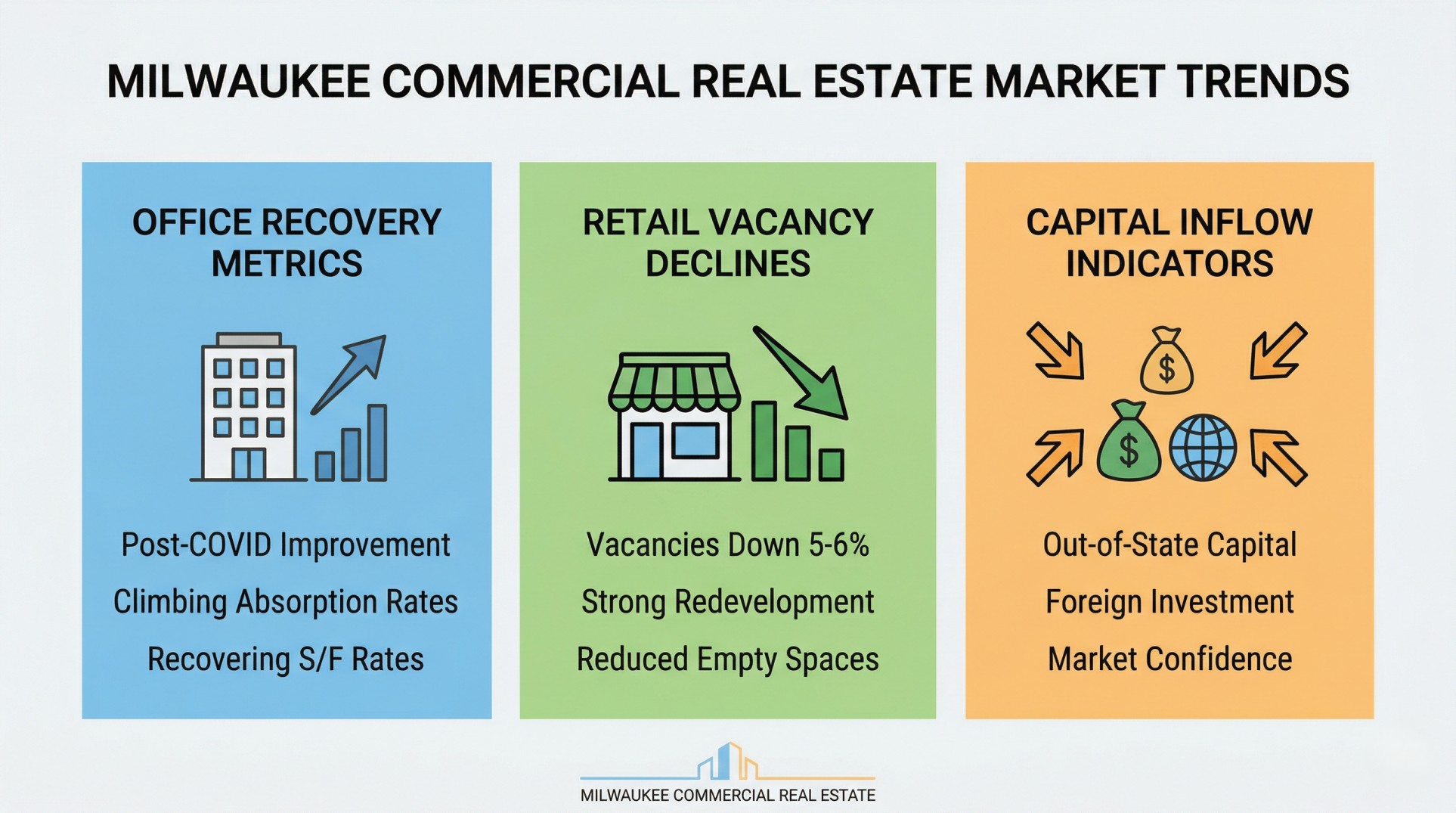
I asked Devan Dorzok where commercial real estate in Milwaukee offers the best value right now. He pointed to two sectors.
Office space is showing post-COVID improvement. Absorption rates are climbing and square-foot rates are recovering, though vacancy remains elevated. For patient investors willing to accept short-term risk, it’s a buy-low opportunity. National commercial real estate vacancy patterns are shifting, and Milwaukee’s office market reflects that broader movement.
Retail has progressed further. Vacancies are down 5 to 6% over recent quarters, driven by redevelopment activity including the Northridge Mall transformation on the city’s north side.
“It’s a competitive market, so the prepared and educated investor is the one who’s going to succeed. If you jump in thinking you’re going to buy a three-unit retail mini-strip and make $10,000 a month, you’re not. Setting good expectations, understanding the market, and really doing your due diligence on what property type you’re going after, what your target market is, what your price range is, and how you’re going to operate it, that’s what makes the difference between success and failure. There’s plenty of opportunity and value coming into Wisconsin, especially Milwaukee, from out-of-state and even some foreign investors. You just can’t rush into it.”
How to Break Into Commercial Real Estate — Devan’s Advice for New Investors
Devan has one piece of advice for beginners starting in multi family real estate investing. Don’t go solo on your first deal. The mistakes are too expensive, and the opportunity cost of a bad decision dwarfs the cost of professional guidance.
Access to multiple sources of credit, maintaining liquidity, and keeping reserves are non-negotiable in the commercial space. Veterans can leverage zero-down financing through VA loans for qualifying properties, but operating capital still needs to be in place. Programs like the Flow Authority’s coaching model help investors build that foundation before their first deal.
The commission math surprises most of Devan’s clients. At 6%, his brokerage fee regularly saves investors hundreds of thousands compared to navigating commercial transactions alone. It pays for itself as protection against a much more expensive learning curve.
Aspire Milwaukee and Building the Next Generation of Commercial Investors
Devan Dorzok’s commercial real estate work in Milwaukee extends beyond NAI Pfefferle. He co-founded Aspire Milwaukee, a community startup helping young, serious investors access deals, build knowledge, and connect with other practitioners. Join Aspire Milwaukee on Facebook, or connect with Devan on LinkedIn, Instagram, or Facebook to get involved.
The mission aligns with what we’re building through the Cash Flow Authority: investor education, deal access, and a network that treats this as a profession. If you’re in Milwaukee or anywhere in Wisconsin, both Aspire Milwaukee and our Cashflow Accelerator are strong places to start your commercial real estate investing journey.
Key Takeaways
Real estate investing is a business. It has income, expenses, systems, legal structures, and operational requirements like any other business model.
You don’t need millions in the bank to access larger commercial deals. Creative financing, seller financing, and strong partnerships get you there faster.
Military discipline (failing fast, building systems, elevating those around you) is one of the most transferable skill sets in real estate.
The Milwaukee and Fox Valley markets offer genuine buying opportunities in post-COVID office and rebounding retail for the prepared investor.
Working with a commercial broker saves you money. Devan’s 6% commission has saved his clients hundreds of thousands.
The biggest barrier to getting started is mindset. Lenders and capital partners are available if you’re educated and prepared.
Frequently Asked Questions
What is the difference between residential and commercial real estate investing?
Residential real estate typically covers 1 to 4 unit properties with conventional financing and simpler tenant management. Commercial real estate (5+ units, office, retail, industrial) requires more capital, complex lending, and deeper knowledge of lease types and market dynamics. The business fundamentals apply to both, but commercial investing demands more sophistication and due diligence.
How do you start investing in commercial real estate with limited funds?
Creative strategies like seller financing, partnerships, and syndications can give you access to properties far beyond your personal capital. Devan Dorzok pursued a 96-unit apartment building using seller financing well before he had significant capital. The key is building your education, maintaining liquidity, and working with experienced brokers who can structure deals on your behalf.
What is a triple net lease and why does it matter for commercial investors?
A triple net (NNN) lease requires the tenant to pay base rent plus property taxes, insurance, and maintenance costs. NNN leases are generally the most favorable structure for investors because they shift operating expenses to the tenant and provide more predictable cash flow. Other common structures include gross leases (landlord covers costs) and modified gross leases, which split responsibilities.
What are the biggest commercial real estate opportunities in Milwaukee right now?
Devan Dorzok identifies two key areas in the Milwaukee and Fox Valley markets: post-COVID office (improving absorption, buy-low for patient investors) and retail (vacancies down 5 to 6%, major redevelopment including Northridge Mall). Out-of-state and foreign capital is actively flowing into Milwaukee, reinforcing market confidence.
What is NAI Pfefferle and how can Devan Dorzok help commercial real estate investors?
NAI Pfefferle is one of Wisconsin’s leading commercial real estate brokerages, with offices in Milwaukee, Appleton, Green Bay, Sheboygan, and Wausau. Devan Dorzok is an associate advisor for commercial real estate in the Milwaukee and Fox Valley markets. He works with investors, business owners, and developers across the Midwest. Connect with Devan on LinkedIn, Instagram, or Facebook, or visit naipfefferle.com.
Apply to Be a Guest on the Cash Flow Authority Podcast
Devan went from zero financial education to negotiating seller financing on a 96-unit apartment building. That conversation happened because he treated real estate like a business, built the right relationships, and wasn’t afraid to go after deals most people would walk past.
If you’re doing real work in real estate and have something worth sharing with investors who are serious about building, we want you on the show.
Disclaimer: The Flow Authority makes no promise or guarantee of any results, money, success, or lifestyle from learning real estate investing strategies. The information provided in this blog is for educational and informational purposes only and should not be considered financial, legal, or professional advice. The views expressed in this blog are those of the author and do not necessarily reflect the official policies or positions of any organization, government agency, or financial institution. Any personal experiences shared are for illustrative purposes only and may not apply to every person's situation. This information is general, not personal. Seek specific advice from a licensed professional for legal, financial, and business decisions. There are no typical results in real estate investing; every person, property, and transaction is unique. The information shared in this blog is believed to be truthful, accurate, legal, moral, and ethical, and is subject to change.