


Dimitry Farberov of Compound Planning: Real Estate, Tax Strategy, and Wealth Building
At thirteen, Dimitry Farberov lost his bar mitzvah money on a stock tip from a family friend. He thought he'd be a millionaire by fourteen. The stock went to zero, but that early loss kicked off a two-decade study of behavioral finance, capital markets, and the decisions people make with hard-earned money.
I sat down with Dimitry on a recent episode of the Cash Flow Authority podcast to talk about what he's learned advising high-net-worth clients for over 18 years. As a Principal and Senior Wealth Advisor at Compound Planning, he manages roughly $225 million in client assets, and his perspective on tax strategy, diversification, and estate planning pushed me to rethink several assumptions I've been carrying.
One detail I keep coming back to from our conversation: Dimitry told me about a 95-year-old real estate entrepreneur in Los Angeles who hadn't paid a dollar in capital gains taxes since 1948. That's the kind of structural, long-range thinking this episode gets into.
We pulled a few of the best moments from this one. Check out the highlights below.
For the full conversation on wealth building, tax traps, and the planning framework Dimitry uses with his clients, the entire episode is right here.
That level of strategic thinking is what we build every episode around at The Flow Authority. Catch more conversations like this one on Facebook and Instagram, and follow Dimitry directly on X and LinkedIn.
My Conversation with Dimitry Farberov: Rethinking Wealth as an Investor

Dimitry's path into finance started with a loss and a book. After watching his bar mitzvah investment go to zero, someone gifted him a book on Warren Buffett and Charlie Munger. By fourteen, he was doing balance sheet analysis. Coming from a family of engineers, the question of how things work pulled him deeper into markets, human behavior, and why smart people make terrible financial decisions.
After advisory roles at Miracle Mile Advisors, IDB Capital, RSM Wealth Management, and Comerica Wealth Management, he landed at Compound Planning. His approach fuses fundamental analysis, behavioral finance, and technical analysis. That combination is what makes Dimitry Farberov's work at Compound Planning effective for people who've built significant income but haven't yet built a strategy for what comes next.
Why Most Investors Lose Years Trying to Do It Alone
This one hit close to home. Before I found the right mentors in real estate, I spent three years trying to figure it all out myself. I was working with an agent who wasn't even focused on investors, just using him to show me listings. That cost me time and money I won't get back.
Dimitry sees the same pattern constantly with his engineering clients:
"They are very smart and they like to teach themselves every part of the process and do it themselves. Oftentimes, they lose decades of opportunity because they don't hire advisors who can help them see their own blind spots. They eventually learn and become decent investors over time, much better than the average individual, but that journey just takes so much longer. They often don't want to pay a fee for that service because they feel they can do it themselves. But that journey can take quite a bit of time, money, sweat, and tears. It's generally not worth it if you can skip that part by having a fiduciary advisor in your corner."
The compounding effect of those lost years is what most people underestimate. A decade of suboptimal returns costs you everything that money would have earned in the decades that follow.
The Foundation of Wealth: Cash Flow and Financial Clarity
Financial planning for high net worth individuals starts where Dimitry starts every client relationship: the numbers. You can't make a sound investment decision without full transparency on your balance sheet.
"I think the most important part about investing in general is having transparency around the balance sheet and an income statement. One doesn't just become a real estate investor or a stock investor; it's about understanding your cash flows. If you have positive cash flows over a period of time that you can project into the future and you have no debts, now you can project how to optimize those cash flows."
Many want to buy rental properties, but they're carrying credit card debt at 20-plus percent interest. That math doesn't close, no matter how good the deal looks.
Key Steps to Financial Clarity:
Map your full balance sheet: Include income, debts, recurring expenses, and net cash flow.
Eliminate high-interest debt first: Do this before directing capital toward investments.
Project your cash flows 5–10 years forward: Use realistic return assumptions.
Identify your investor personality: Understand what drives you and what keeps you up at night.
Work backwards from your goal: Determine the return profile and risk level you need.
Balancing Real Estate and Traditional Investments
I asked Dimitry how real estate investors should think about balancing properties with traditional portfolios. His answer came back to personality and self-awareness.
Some investors find real estate boring; others are driven by it. Dimitry's framework is to understand your cash flow situation first, then project five to ten years ahead. If you're saving $10,000 a month, what return do you need to hit your goals? That target shapes the investment vehicle, the risk profile, and whether you lean into real estate, equities, or both.
Plenty of investors build strong portfolios through real estate education and coaching because the asset class fits how they think and what they're willing to manage directly.
Diversification vs Focus: When Each Strategy Wins
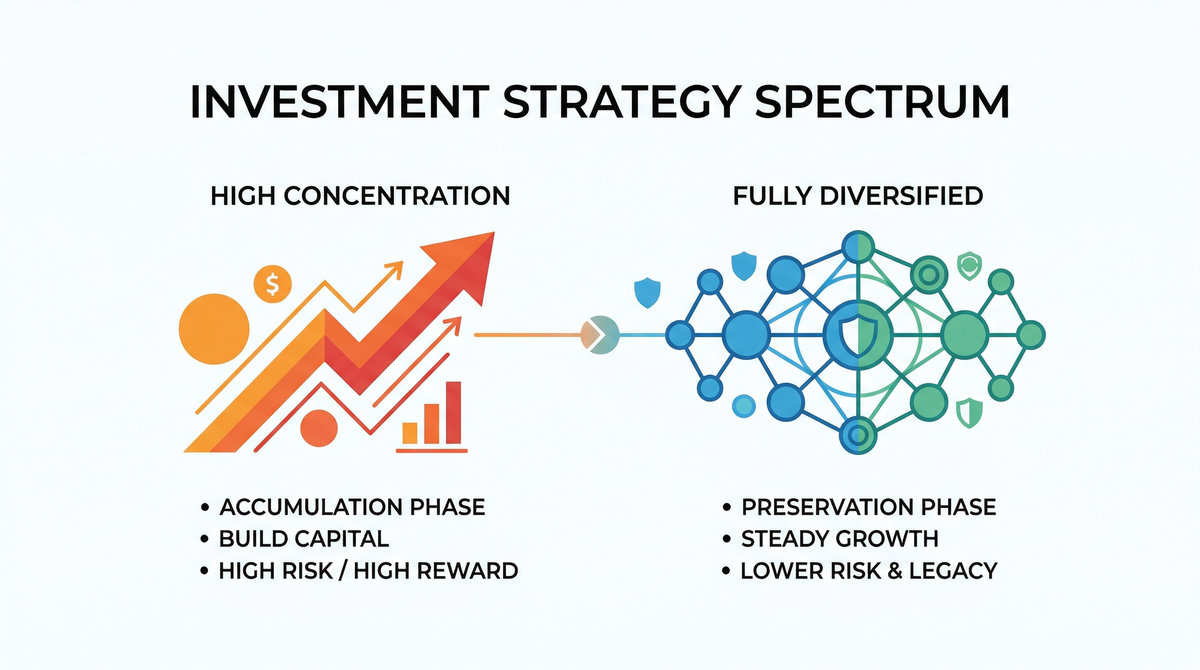
The question of diversification vs concentration investing comes up in every wealth conversation, and Dimitry broke it down by life stage in a way that shifted my thinking. For his clients with average liquid assets around $7 million, diversification is about legacy, tax planning, and preservation. For someone still in the accumulation phase, concentration may be the faster path.
"Diversification is a tool to not lose money, but it's not necessarily the best tool to make money in a short period of time. Over a period of 30 or 50 years, I think it is the best methodology to achieve multi-generational net worth. Ultimately, when we think about our careers, we're not diversified. We don't get ten jobs; we get one job and hope that business is good and has longevity so you can use the cash flows to leverage and compound over time."
That career analogy landed with me. Nobody tells a surgeon to diversify into plumbing. You go deep, build capital, then diversify once preservation matters more than growth.
The Truth About Market Returns and Expectations
Dimitry brought up a stat worth sitting with: the S&P 500 has returned roughly 10% annually over the last 100 years. Very few individual years have actually landed at exactly that number, but it's the long-term baseline. The question for any investor is whether 10% is sufficient.
If you think 10% is a poor return, you probably shouldn't be sitting in index funds. If you think it's great, you still have to consider the price you're paying today. Dimitry told me he's currently telling clients that next-decade S&P expectations should sit in the 3–5% range because valuations are historically elevated.
One advantage real estate holds here is leverage. Put 25% down on a property and you magnify a 7% return considerably. You can technically do the same with stocks via margin, but Dimitry doesn't recommend it for most people.
The Biggest Tax Planning Mistakes Investors Make
Smart tax strategies for real estate investors start with structure. The biggest mistake Dimitry sees is investors buying their first property without thinking about whether today's entity setup will serve them 30 years from now.
If your net worth eventually exceeds the lifetime gift and estate tax exemption ($15 million per individual as of 2026), your heirs face a 40% tax on everything above that threshold. But if you don't need the cash flow from a property, you can park it outside your estate early, while the valuation is low, and the entirety of the growth stays outside.
Plan the structure before you make the investment. That single habit separates the investors who preserve wealth from those who hand half of it to the IRS.
Smart vs Costly Tax Strategies
Why Real Estate Has a Tax Advantage Over Other Assets
Dimitry made a point that frustrated him: the tax code was written for real estate investors more than any other asset class. Depreciation, 1031 exchanges, cost segregation, and entity structuring create tax efficiency stock investors simply don't get.
I asked about 1031 exchanges specifically. If you're yielding 5% on a highly appreciated property that's becoming a headache, swapping into a DST or 721 fund for 6% without paying the gains makes sense. But if you're earning 30% and the replacement only yields 7%, you're better off paying the tax and redeploying on your own terms.
The IDEAL framework (Income, Depreciation, Equity, Appreciation, Leverage) maps directly to these advantages. Building wealth through real estate with these tools is what separates casual investors from serious ones.
Estate Planning Starts on Day One
Estate planning for investors starts from day one, and Dimitry didn't hedge on this. Step one is risk management, which means a basic living trust, healthcare directives, and a pour-over will. In states like California, where probate is expensive and slow, you don't want your family fighting over assets that should've been structured in advance.
"Even with a conservative growth profile of 6% on your assets, what does that project to over 30 or 50 years? If that projects to be north of the lifetime gift exemption (which as of 2026 is $15 million per individual or $30 million for a married couple), that's a big hurdle. I do think that number is going to drop considerably due to political trends. Let's say that number is $10 million; any dollar above that at the time of both spouses passing is going to be taxed at 40%."
The investors who get this right project forward and build the structure backward. The ones who don't face a tax bill their heirs can't pay without selling the assets they were meant to inherit.
Advanced Wealth Strategies High-Net-Worth Investors Use
For clients already above or approaching the gift exemption threshold, Dimitry works with several advanced tools:
Spousal Lifetime Access Trusts (SLATs): Park assets in a trust for your spouse, freeze the estate value, and let all future growth happen outside the taxable estate.
Irrevocable trusts for generation-skipping tax: Shield multi-generational transfers from being taxed at each level of inheritance.
Charitable trusts: Gift a low-basis asset, sell it inside the trust at zero capital gains, and create a tax-efficient annuity stream for 10–30 years. You get a deduction on the gift and diversified holdings without a taxable event.
These tools exist in the tax code. Most investors don't discover them until it's too late.
Real Estate Investors and the Estate Tax Trap
Real estate creates a specific problem that stock investors rarely face: illiquidity at the worst possible moment.
If you're worth $50 million in real estate and you pass away, 40% of the value above the exemption is owed to the IRS within nine months. You can't write a check on a building. Dimitry mentioned George Steinbrenner of the Yankees, who bought a $100 million insurance policy because you aren't going to sell the Yankees to cover a tax bill. Farm owners face the same trap. If you watched Yellowstone, that was the central tension: massive land value, no liquidity.
The fix for this is planning now. Move assets outside your estate while the exemption is high and use insurance for liquidity before the bill shows up.
The One Wealth Principle Every Investor Must Follow
If there's one thread running through everything Dimitry shared, it's the value of guided expertise:
"Sometimes we have to go through that process to become great investors or great at whatever we do. But having that coach or mentor guide you is a shortcut. Shortcuts aren't necessarily the way to go in life, but I do think having a coach is definitely going to guide you to the destination much more quickly."
I lived this. Three years of avoidable mistakes before I found the right people to learn from. Every investor I know who accelerated fastest had one thing in common: they paid someone who'd already been through the pain. Whether that's a wealth advisor like Dimitry or a structured coaching program that gets you to your first deal, the return on good guidance dwarfs whatever fee comes with it.
If you're a high-performing professional building wealth through real estate or balanced portfolios, the principles Dimitry Farberov shared from his work at Compound Planning are worth building on. The Flow Authority community exists for exactly these conversations.
Frequently Asked Questions
Should real estate investors diversify or focus?
It depends on your stage. During accumulation, concentration in an asset class you know deeply can generate higher returns. Once your priority shifts to preservation, diversification protects against catastrophic loss and supports multi-generational planning.
When should I start estate planning?
Immediately. A basic living trust, healthcare directives, and a pour-over will protect your assets from probate. Even if your net worth is modest today, projecting forward at a conservative growth rate often reveals estate tax exposure is closer than you think.
What's the biggest mistake investors make?
Failing to plan the structure before making the investment. Most investors buy first and figure out the entity, tax, and estate implications later, locking themselves into a framework that costs far more to unwind than it would have cost to build correctly from the start.
Apply to Be a Guest on the Cash Flow Authority Podcast
This conversation with Dimitry Farberov of Compound Planning covered tax strategy, estate planning, diversification, and the blind spots that cost investors decades.
If you're a wealth advisor, tax strategist, or real estate professional with hard-won lessons like these, the Cash Flow Authority audience wants to hear them.
Disclaimer: The Flow Authority makes no promise or guarantee of any results, money, success, or lifestyle from learning real estate investing strategies. The information provided in this blog is for educational and informational purposes only and should not be considered financial, legal, or professional advice. The views expressed in this blog are those of the author and do not necessarily reflect the official policies or positions of any organization, government agency, or financial institution. Any personal experiences shared are for illustrative purposes only and may not apply to every person's situation. This information is general, not personal. Seek specific advice from a licensed professional for legal, financial, and business decisions. There are no typical results in real estate investing; every person, property, and transaction is unique. The information shared in this blog is believed to be truthful, accurate, legal, moral, and ethical, and is subject to change.