


James Loffredo on Private Lending & DSCR Loans for Investors

I recently closed a DSCR refinance, and the lender who walked me through it made a complicated process feel straightforward. That lender was James Loffredo, founder of Pinnacle Funding Network. When I got him on The Cash Flow Authority podcast, I wanted to dig past the surface-level talk and get into the mechanics that actually matter: how the loans work, what the numbers look like, and why so few investors understand the options available to them.
What stuck with me most was his take on a deceptively simple strategy: buying one rental per year and refinancing every five years can compound into something serious over a decade. That single idea, modeled out over 20 years, can reshape someone's financial trajectory entirely.
We pulled a few of the sharpest moments from this conversation. Give them a watch before you read on.
The full episode gets into DSCR math, the difference between private lending and bank financing, and why James thinks most investors wait too long to call a lender. If you want the whole conversation from start to finish, it's right here.
James is the kind of lender who talks about deals the way he structures them, with zero fluff. You can see that firsthand on his Instagram.
If you want more conversations like this one and a look at what we're building at The Flow Authority, follow along on Facebook and Instagram.
Introduction to James Loffredo and Pinnacle Funding Network

James Loffredo is the founder and principal of Pinnacle Funding Network, a Dallas-based real estate financing firm that provides capital solutions to investors nationwide. He specializes in structuring investor-focused lending products including DSCR rental loans, bridge financing, fix-and-flip loans, and new construction funding.
In our conversation, we covered how investors actually qualify for these products and why the approach James Loffredo and Pinnacle Funding Network take on private lending stands apart from the bigger shops. The specifics he shared are worth hearing, especially if you're trying to figure out which loan type fits your situation. We also got into bridge loans for real estate investing, how debt can become a scaling tool, and why the lending side of this business is still wide open for growth.
From Family Business to Real Estate Financing
James didn't come from finance. His path into private lending started in a fifth-generation family business that had nothing to do with real estate, and the pivot he made carries lessons for anyone sitting in a career that fits on paper but doesn't fit in practice.
"My life plan didn't start like this, but that's the beauty of it. I went to school for business and always had a passion for entrepreneurship. I was actually born and raised in a fifth-generation family business in food distribution and trucking, the complete opposite of real estate and finance. I spent my initial career working my way up through that business, but once I got to the top and looked at my future, I realized it wasn't what I wanted to do. I took a step back and asked myself, 'If I could start over, where are my passions?' I loved finance and real estate."
That realization led him to a mentor in Dallas who worked at a private lending firm. James joined the sales team, eventually managed it, and after four years saw gaps in how lenders were serving investors. He launched Pinnacle Funding Network about a year and a half ago with a boutique, hands-on approach the larger firms weren't providing. I know what that transition feels like. I left my own career to go full-time into real estate, and the moment you realize the corporate track isn't the finish line, everything shifts. If you're curious about my story and how I got here, the parallels with James's path are striking.
What Private Lending Really Means in Real Estate
The term "private lending" gets thrown around loosely, and James was direct about clearing up the confusion. Before the 2008 financial crisis, investment property financing was straightforward: you went to a bank. After the collapse, banks pulled back from investor loans, and private markets filled the vacuum.
"Pre-2008, if you wanted to buy a rental, you went to a bank. After the 2008 collapse, banks were no longer as interested in financing residential real estate for investors. Private markets stepped in by raising capital and securitizing it from Wall Street. Private lending is capital from private companies used to purchase and rehab homes. One of the primary products is the DSCR loan, which looks like a 30-year mortgage but focuses on the property rather than the borrower's personal income."
Private lending real estate financing now covers several distinct products, and understanding which one fits your situation matters:
DSCR rental loans for long-term buy-and-hold investors
Fix-and-flip loans for investors rehabbing properties to resell
Bridge loans for short-term capital needs between transactions
New construction funding for ground-up development projects
One detail James emphasized: all private lending is technically a business-to-business transaction. That's why firms like Pinnacle can operate in all 50 states without the banking regulations that limit traditional lenders.
The Growth of Private Lending in Real Estate
James came prepared with numbers, and they were bigger than I expected. The private lending sector had one of its strongest growth years on record, with transaction volume jumping from $97.8 billion in 2024 to $121.2 billion in 2025. When James asked me to guess what percentage of total residential transactions that $121.2 billion represented, I said less than 1%. The real answer was 18%.
That number stopped me. Private lending already accounts for a significant share of residential real estate activity, and the fix-and-flip market alone accounted for 245,000 homes last year. Total residential transactions run into the trillions, which means there's still massive room for this sector to grow. These are mainstream real estate investor financing options, and the trajectory is clear.
How DSCR Loans Work for Rental Properties
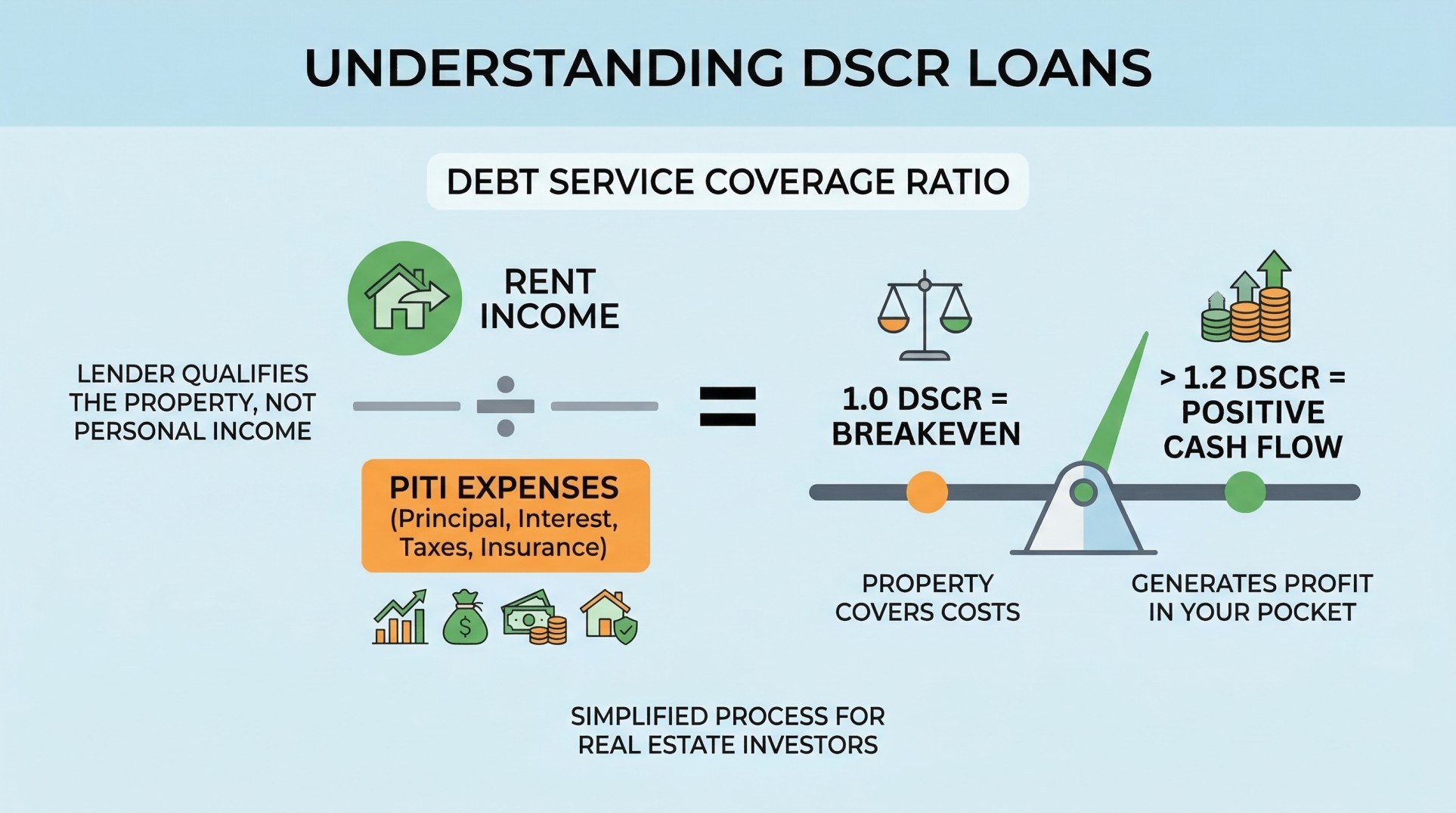
DSCR loans for real estate investors were the centerpiece of our conversation, partly because I'd just closed one with James's team. DSCR stands for Debt Service Coverage Ratio, and the premise is straightforward: instead of qualifying based on your personal income, the lender qualifies the property itself.
"DSCR stands for Debt Service Coverage Ratio. Rather than looking at your W-2 income or your debt-to-income ratio, we look at one property. We take the rent collected and divide that by the PITI: Principal, Interest, Taxes, and Insurance. A 1.0 ratio means you are breaking even. Even when rates are high, a 1.0 means you're covering your costs. Anything above 1.0 is profit in your pocket."
I've now done both a DSCR loan and a traditional commercial loan on a five-unit property. The difference in underwriting is stark. The commercial side wanted 12 months of P&L statements, vacancy analysis, and cap rate projections. The DSCR process focused on one question: does the rent cover the payment?
James was clear that his firm stays focused on one-to-four-unit residential properties, though they can handle up to 10 units and occasionally 20 with certain products. Once you hit five units, the deal structure shifts to commercial-style terms. Knowing where your lender specializes keeps you from getting bad advice. If you're evaluating which loan structure fits your investment strategy, that clarity matters before you ever submit an application.
Why Debt Can Be a Powerful Tool for Investors
There's a mindset hurdle that stops a lot of would-be investors from ever buying their first property. James and I talked about the Dave Ramsey approach to debt during the episode. The Ramsey playbook makes sense for paying down consumer debt. Investors trying to scale a portfolio need a fundamentally different relationship with leverage.
James put it plainly:
"You have to understand that debt is your friend when utilized correctly. If you can't get over those two humps, spending money and using debt, you're going to struggle."
At a conference I attended recently, the speaker said something that stuck with me: stop worrying about spending money on appraisals and inspections. If a few hundred dollars on due diligence feels like a risk, this space will be a constant source of stress. Bridge loans, fix-and-flip financing, DSCR products: all of these use leverage to turn one property into two and two into five. The mechanics only work if you treat debt as a tool, not a threat.
That said, there's a line between leverage and recklessness. I've watched investors overextend because they forgot to run the numbers on each deal. Every property needs to pencil out on its own. The moment you're hoping one investment subsidizes another, you've crossed into dangerous territory.
The Buy One Rental Per Year Strategy
I thought about this one the night before we recorded. The math is straightforward, and James confirmed it's probably the single best approach for someone still working a W-2 job who wants to build real wealth through real estate.
"If I were still in a W-2 job, that is probably what I would do. It's an easy thing you can build out in Excel or using AI models like Claude. You could build a 20-year model of working a W-2 job and putting 20% down on a turnkey rental. After five years, you refinance, pull equity, and suddenly you're buying two a year. I think what you just described is the best way to build wealth in this space."
Here's how the strategy breaks down in practice:
Years 1 through 5: Buy one turnkey rental per year using DSCR financing.
Years 6 through 10: Use the equity from appreciation and mortgage paydown to buy one additional property per year for a total of two per year.
Year 11 and beyond: Scale to three or more acquisitions annually as cash flow and equity compound.
My first rental was a duplex in Manitowoc, Wisconsin. Turnkey, found on the MLS, and it's been the lowest-maintenance, most consistent cash flow property in my portfolio. You don't need to start with a complicated deal. A boring, cash-flowing duplex in a Midwest market can be the foundation of something much bigger. I've written more about strategies like this on the Flow Authority blog for W-2 investors ready to take that first step.
Why Real Estate Investing Is a Team Sport
James made a point that I've come to believe is the single most important factor separating investors who scale from those who stall: you can't do this alone.
He referred me to a property manager in Wisconsin without me even asking, because that's what good partners do. They solve problems you haven't articulated yet. That's part of what James Loffredo built at Pinnacle Funding Network: a private lending operation where the person closing your loan is the same person who owns the company.
"Social media has jaded the space, but you're actually out there doing it, talking to brokers and lenders every day. That's the type of person people should want to work with. When people work with us, they work with me directly as the owner, not a sales team of a hundred people. You can't be a lone wolf in this industry; it's a team sport."
The right team includes a lender who understands your asset class, a property manager who treats your investment like their own, an agent who knows the local inventory, and a contractor you can trust with the rehab scope. Trying to fill all of those roles yourself is how investors burn out by deal three.
Finding the Right Private Lender
With over 10,000 private lenders operating nationwide, picking the right one is a real problem. James was candid about how inconsistent the space can be, partly because there's no central regulatory body governing private lending the way banking is regulated.
"Because there is no central governance for the industry, finding a private lender you can trust is vital. You want someone who will guide you in the right direction, not just anyone who sends a cold email. We like to stay in our lane. We focus on one-to-four units. We know that space inside and out. Out of those 10,000 private lenders across the country, it's important to find one that knows your specific niche."
James's advice for new investors: don't wait until you have a property under contract to talk to a lender. Reach out while you're evaluating deals so you understand the terms, timeline, and documentation you'll need. If you're doing a rehab-to-rental, you need to be especially methodical because the loan structure depends on the scope of work.
The terminology itself trips people up. "Hard money lending" originally meant lending against a hard asset, but the phrase picked up a negative reputation. "Private lending" became the preferred term, though the products are essentially the same. Finding a lender who explains the differences without hiding behind jargon is worth more than the lowest rate quote you find online.
FAQ Section
Who is James Loffredo?
James Loffredo is the founder and principal of Pinnacle Funding Network, a Dallas-based firm that provides capital solutions to real estate investors nationwide. He specializes in DSCR rental loans, bridge financing, fix-and-flip loans, and new construction funding.
What is a DSCR loan?
A DSCR loan is a type of real estate investor loan where qualification is based on the rental income of the property rather than the borrower's personal income. The lender calculates the Debt Service Coverage Ratio by dividing the property's rental income by its total expenses, including principal, interest, taxes, and insurance.
What types of loans do private lenders offer?
Private lenders commonly offer DSCR rental loans, bridge capital, and construction financing for property investors. These products serve different strategies depending on the timeline and exit plan. Fix-and-flip loans are also popular for investors who rehab properties intended for resale.
Can W-2 employees invest in real estate using private lending?
Yes. Many real estate investors maintain full-time jobs while using private lending to acquire rental properties and gradually build a portfolio. DSCR loans are particularly popular with W-2 investors because they qualify based on property income rather than personal income. For more on how James Loffredo and Pinnacle Funding Network approach private lending for investors at every level, listen to the full episode on the Cash Flow Authority podcast.
Apply to Be a Guest on the Cash Flow Authority Podcast
Private lending is reshaping how investors build portfolios, and the playbook is still being written. If you're a lender, investor, or operator who's actively structuring deals, scaling with DSCR products, or solving financing problems most people don't even know exist, we want to hear your story.
Disclaimer: The Flow Authority makes no promise or guarantee of any results, money, success, or lifestyle from learning real estate investing strategies. The information provided in this blog is for educational and informational purposes only and should not be considered financial, legal, or professional advice. The views expressed in this blog are those of the author and do not necessarily reflect the official policies or positions of any organization, government agency, or financial institution. Any personal experiences shared are for illustrative purposes only and may not apply to every person's situation. This information is general, not personal. Seek specific advice from a licensed professional for legal, financial, and business decisions. There are no typical results in real estate investing; every person, property, and transaction is unique. The information shared in this blog is believed to be truthful, accurate, legal, moral, and ethical, and is subject to change.