


Jason Ottilo: Next Legacy Group Multifamily Investing Insights
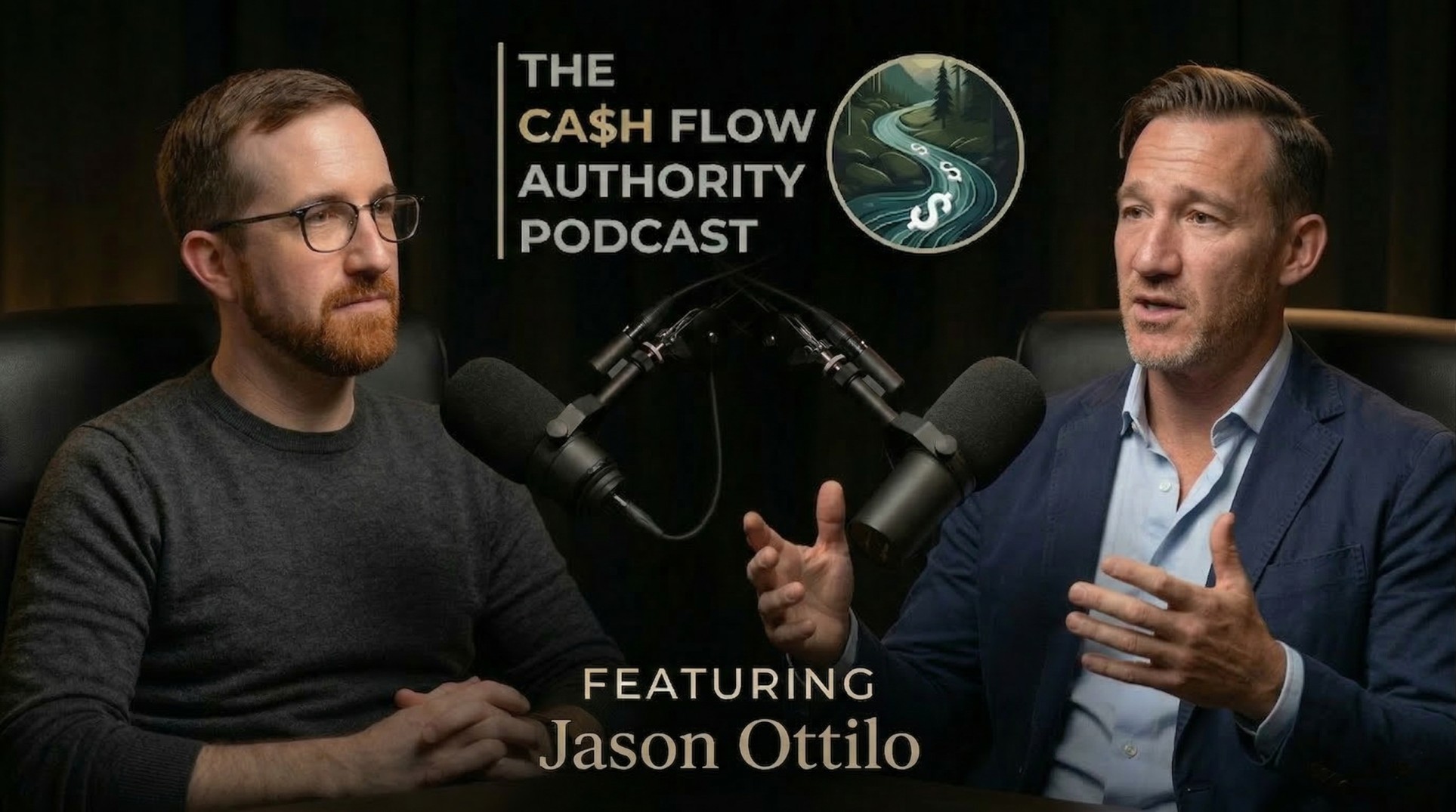
I sat down with Jason Ottilo of Next Legacy Group to talk about multifamily investing on the Cash Flow Authority podcast, and the conversation went places I didn't expect. Jason spent 28 years climbing from entry-level phone rep to healthcare executive at Express Scripts—no degree, no real estate background, just relentless curiosity about how money actually works. Then one afternoon, his wife pulled up a Grant Cardone webinar on her phone at a Starbucks, and the next four hours rewired his entire career trajectory. He filled pages of notes, walked out convinced that apartment buildings were the answer, and never looked back.
What he's built since then—a vertically integrated firm with six partners, 500-plus multifamily units, an RV park in Arkansas, and an underwriting model that stress-tests every deal down to 66% occupancy—is the kind of operation most first-time investors assume takes decades to reach. Jason got candid about the hardest parts too: raising capital from investors who've only ever known a 401(k), interviewing property managers face-to-face before closing, and structuring exits flexible enough to weather any market cycle.
If you want the full conversation, every tangent into stress-testing at 66% occupancy, every story about a four-hour Starbucks webinar that changed everything, the whole episode is right here.
This is the kind of conversation I built the Cash Flow Authority around: operators who've actually done the math and bet on it. Jason breaks down his underwriting logic and deal structures on LinkedIn, and the Next Legacy Group Facebook page tracks their acquisitions and investor updates as they happen.
Introduction to Jason Ottilo and Next Legacy Group

Jason Ottilo is a real estate investor and co-founder of Next Legacy Group, a firm built around acquiring and managing income-producing assets for accredited investors. His portfolio includes participation in over 500 multifamily units and an RV park in Arkansas, with a specialization in strategic underwriting and long-term cash flow growth. The firm is vertically integrated: partners bring expertise in construction, property management, legal, and investor relations, all under one operational umbrella.
What separates Jason from the typical multifamily operator is his backstory and how it shaped his risk tolerance. Nearly three decades in healthcare taught him how to evaluate downside scenarios before making any decision, a skill that now defines how Next Legacy Group underwrites every acquisition. When his team models a new deal, they don't start with best-case projections. They start with what happens if 34% of the building goes vacant and expenses rise at the same time. If the deal survives that scenario, they move forward. If it doesn't, they walk.
On the capital-raising side, Jason's biggest challenge isn't sourcing deals. It's educating investors who've never been exposed to anything outside a brokerage account. He spends real time explaining how syndications work, why multifamily offers a risk profile that single-family can't touch, and how real estate lets you physically see and improve the asset your money sits in. That transparency is what he leans on hardest when talking to new investors.
From Healthcare Executive to Real Estate Investor
Jason's transition started with a creative move. Before he and his wife bought their home in Jacksonville around 2018, she got her real estate license. She earned the commission and they rolled it into the down payment, putting almost nothing down. That single transaction proved that real estate had financing angles most people never consider.
"I started working in the healthcare industry for a company called Express Scripts. I got the job simply because it was available; I didn't even have a college degree at the time. I was just making phone calls, but 28 years later, I had become an executive within the company. I always wanted to be a stockbroker. As a kid, I was fascinated with Wall Street. I grew up in New York, right outside the city, and I always felt that was what I wanted to do."
When COVID hit, Jason explored different investment vehicles, tried stock options, and couldn't stomach the volatility. Real estate offered something tangible—a physical asset he could see, walk through, and understand on his own terms. If you're a professional making a similar transition, the story behind The Flow Authority tracks a related path.
Why Multifamily Investing Made More Sense Than Single-Family Rentals
Jason and his wife initially looked at single-family rentals. The math killed the idea fast. He'd clear roughly $25 a month on a $100,000 property while putting his personal credit at risk. For someone who spent three decades evaluating risk, that ratio was unacceptable.
The pivot came from an unlikely source. Jason's wife spotted Grant Cardone on Instagram. His first impression wasn't flattering ("I thought he was a nut job because he was screaming and yelling," Jason told me), but curiosity won. One four-hour Starbucks webinar later, the multifamily real estate investing lightbulb came on. Owning 100 units meant losing five tenants still left 95 people paying rent.
"We initially looked at buying single-family homes, but when I did the math, making $25 a month while putting my credit at risk for a $100,000 property, I couldn't wrap my head around it. It felt like it would take too long. We listened to one of his webinars for four hours in a Starbucks. I was writing everything down and realized it made much more sense to purchase something with 100 units. If five people leave, you still have 95 people paying you."
That shift from one door to 100 doors separates investors who grind for decades from those who build real portfolios in years. If you're still running numbers on your first multifamily deal, this deep dive on financing a 31-unit apartment complex breaks down what the lending side looks like in practice.
Networking: The Real Game Changer in Real Estate
Jason is candid about what accelerated his growth: relationships. He joined Cardone's group and several other masterminds around 2021, and the returns on those connections far outweighed any course content. At a Cardone event, he met Matt Tafiki, who introduced him to investor after investor. One introduction led to an RV park investment. Another led to a partnership with Jake Sisk to purchase a second RV park in Arkansas.
"Networking was the game-changer for me. I met Matt Tafiki at a Cardone event, and he introduced me to person after person. I invested in one of his RV parks, then Matt, Jake Sisk, and I partnered to purchase another RV park in Arkansas."
What I've seen consistently, both on this show and in my own investing, is that the gurus give you the 10,000-foot view, but the people you meet inside those rooms are where the deals actually come from. Jason confirmed this directly. One conversation at the right event is worth more than any online course. These connections are what led to Jason Ottilo co-founding Next Legacy Group with a clear focus on multifamily investing.
Building the Next Legacy Group Team
Jason describes himself as "a guy with great ideas who needs others to handle the details." He'll chase shiny objects, he admits freely, and that self-awareness drove him to build a team that complements his strengths rather than duplicating them.
Next Legacy Group now operates with six partners, each owning a specific lane. Teresa and Laura handle operations and keep the team grounded. Tim, an engineer by training, runs underwriting with custom spreadsheets he built by finding and fixing broken formulas in existing models. The group also partnered with Mandy Monson, who specializes in storage units, and Justin Bennett, who brings construction and property management in-house. That vertical integration means fewer outside dependencies and tighter control over results.
"I am a guy with great ideas who needs others to handle the details. I definitely see shiny objects and want to chase them. That's why I was very specific in choosing my partners. Teresa and Laura are very detail-oriented. They ground me and remind me to finish one project before moving to the next."
Jason didn't recruit warm bodies. He found operators whose instincts balanced his own. That kind of intentional team-building is something I've written about before, particularly for professionals coming from structured careers who want to bring that same rigor into real estate.
How Jason Ottilo Underwrites Multifamily Deals to Protect Investors
Underwriting multifamily deals is where Jason Ottilo and the Next Legacy Group team get surgical. Their process starts with the worst-case scenario and works backward from there. On their current 106-unit acquisition in St. Louis, they modeled the property down to 66% occupancy, layered on increased expenses, and assumed zero rent increases. Even under those conditions, investor capital remained protected.
"We focus heavily on risk and worst-case scenarios. For the property we are taking down now, we modeled it all the way down to 66% occupancy with increased expenses and zero rent increases. Even at that level, the capital is secure. We show that data to our investors."
The team uses CoStar for market data, roughly $25,000 a year. Jason was clear: new investors shouldn't rush to buy it. You need scale before that expense makes sense. Tim built their underwriting engine from a spreadsheet, customizing it deal by deal because "each deal is different, so it's hard to have a one-size-fits-all tool."
U.S. rental vacancy rates have swung between 5.6% and 11.1% over the past two decades, which is exactly why stress-testing against low occupancy remains a non-negotiable practice for serious operators.
The Hardest Part of Real Estate: Raising Capital
Jason didn't sugarcoat it: raising capital for real estate deals is the hardest part of the business. Every investor has a different "why," and most only understand 401(k)s and the stock market. Explaining that they can invest in a 100-unit apartment complex requires patience and education at every step.
Global real estate investment volume topped $888 billion in 2025 alone, yet most accredited investors have never been offered a way to participate directly. Jason's approach: show the data, show the downside protection, let the numbers speak.
"Raising capital is the hardest part because every investor has a different why. Many people don't understand alternative investments. They understand 401ks and the stock market, but investing in a 100-unit complex doesn't always click. I wish this was taught in high school. Real estate is the core of the investment world, valued at somewhere around $200 trillion. Unlike a paper stock, you can drive down the street and actually touch the building you own a piece of."
I've had the same experience. When I started my career, I just knew I was "supposed" to put money in a 401(k), with no clue where it was going. The transparency of real estate changes your entire relationship with capital. If you're making a similar shift, this 90-day accelerator walks through moving from research into your first deal.
Why Multifamily Real Estate Is a Team Sport
Jason put it bluntly: he wouldn't be successful without his team. At scale, multifamily deals require simultaneous execution across legal, lending, investor relations, underwriting, marketing, and property operations. Trying to run all of that solo is how operators burn out or make costly mistakes.
"I would not be successful without my team. All six of us have specific roles, legal, loans, investors, marketing. Doing it alone would be incredibly difficult. Even Grant admits he didn't do it alone; he has a massive team."
On the property management side, Jason's team doesn't hand off keys and disappear. For their RV park, one partner physically moved to the property. For the 106-unit deal, they spent a full day interviewing property managers to confirm they genuinely cared about residents' conditions. That hands-on vetting rarely appears in "passive income" marketing, but it separates performing assets from liabilities.
Building Generational Wealth Through Multifamily Investing
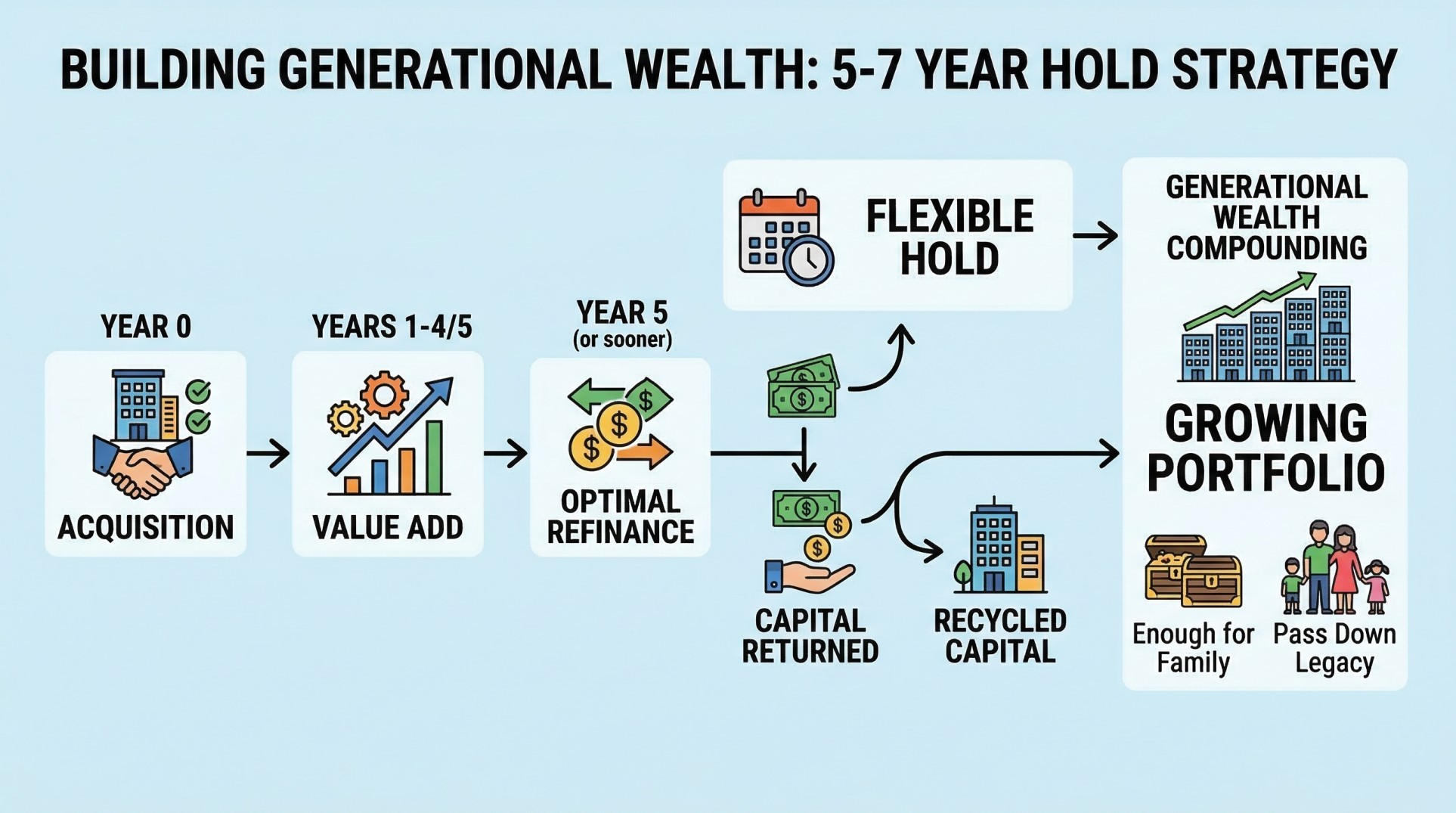
Jason's endgame isn't a $4 billion portfolio. He wants enough for his family and something meaningful to pass to his kids. That mindset shapes every deal Next Legacy Group structures.
Their typical investment horizon runs five to seven years, with built-in flexibility to hold longer if conditions are unfavorable. They pursue refinancing aggressively: if rates drop and operations have driven value up, they return 100% of investor capital while keeping investors in the deal, collecting cash flow risk-free. Recycling capital into the next acquisition is how portfolios compound over time without requiring fresh equity every round.
"No one can predict the future. We structure our deals for five to seven years. If the market is bad at year five, we have the flexibility to hold for two more years until things improve. I don't need to be a $4 billion guy like Grant; I just want enough for my family and to pass something down to my kids."
Jason Ottilo's approach through Next Legacy Group proves that multifamily investing, executed with the right team, conservative underwriting, and flexible timelines, builds generational wealth that a 401(k) statement simply can't match.
Frequently Asked Questions
Who is Jason Ottilo?
Jason Ottilo is a real estate investor and co-founder of Next Legacy Group, a firm focused on acquiring and managing multifamily real estate investments for accredited investors.
What is Next Legacy Group?
Next Legacy Group is a real estate investment firm that acquires income-producing assets and allows accredited investors to participate in multifamily real estate opportunities.
Why do investors prefer multifamily real estate?
Multifamily investing allows investors to scale faster, reduce vacancy risk across multiple units, and generate consistent rental income compared to single-family properties.
What is underwriting in real estate investing?
Underwriting is the process of analyzing a property's financial performance, risks, and market conditions to determine whether the investment is financially viable.
Apply to Be a Guest on the Cash Flow Authority Podcast
Professionals like Jason Ottilo and the Next Legacy Group team are reshaping how multifamily investing gets done. If you're doing similar work in real estate, syndication, or finance, we want to hear your story.
Disclaimer: The Flow Authority makes no promise or guarantee of any results, money, success, or lifestyle from learning real estate investing strategies. The information provided in this blog is for educational and informational purposes only and should not be considered financial, legal, or professional advice. The views expressed in this blog are those of the author and do not necessarily reflect the official policies or positions of any organization, government agency, or financial institution. Any personal experiences shared are for illustrative purposes only and may not apply to every person's situation. This information is general, not personal. Seek specific advice from a licensed professional for legal, financial, and business decisions. There are no typical results in real estate investing; every person, property, and transaction is unique. The information shared in this blog is believed to be truthful, accurate, legal, moral, and ethical, and is subject to change.