


Ken Gee of KRI Partners on Value-Add Multifamily Investing
Most high-performing professionals don't realize they're on a treadmill until a quiet moment forces the question, “Is this really the best life I can build for my family?” That moment hit my guest at 3 a.m. nearly thirty years ago, and it changed the trajectory of his career and his wealth.
I had the pleasure of speaking with Ken Gee of KRI Partners, a fellow 10Xer who walked away from a Deloitte tax career to build a multifamily real estate firm now managing roughly $200 million in assets across about 1,300 units, on my podcast. During our conversation, Ken shares what he's learned operating through every cycle since the late 1990s.
Why I Had This Conversation
I built my career as a civil engineer and Marine Corps veteran, so I'm wired to respect operators who've done the reps. Ken has done the reps. He's been involved in more than $2 billion of transactions, lived through 2008–2009 without losing a dollar of investor capital, and now runs a vertically integrated firm with 45 employees.
What pulled me in wasn't his portfolio size. It was how he framed wealth. The world is full of operators chasing the next dollar. But Ken built something different by getting the order right: time freedom first, then long-term wealth, then teaching others how to do it cleanly.
That's the mindset I want my listeners to absorb if they're going to use real estate as their next challenge worth building.
Value-Add Looks Different at Every Stage of Your Career
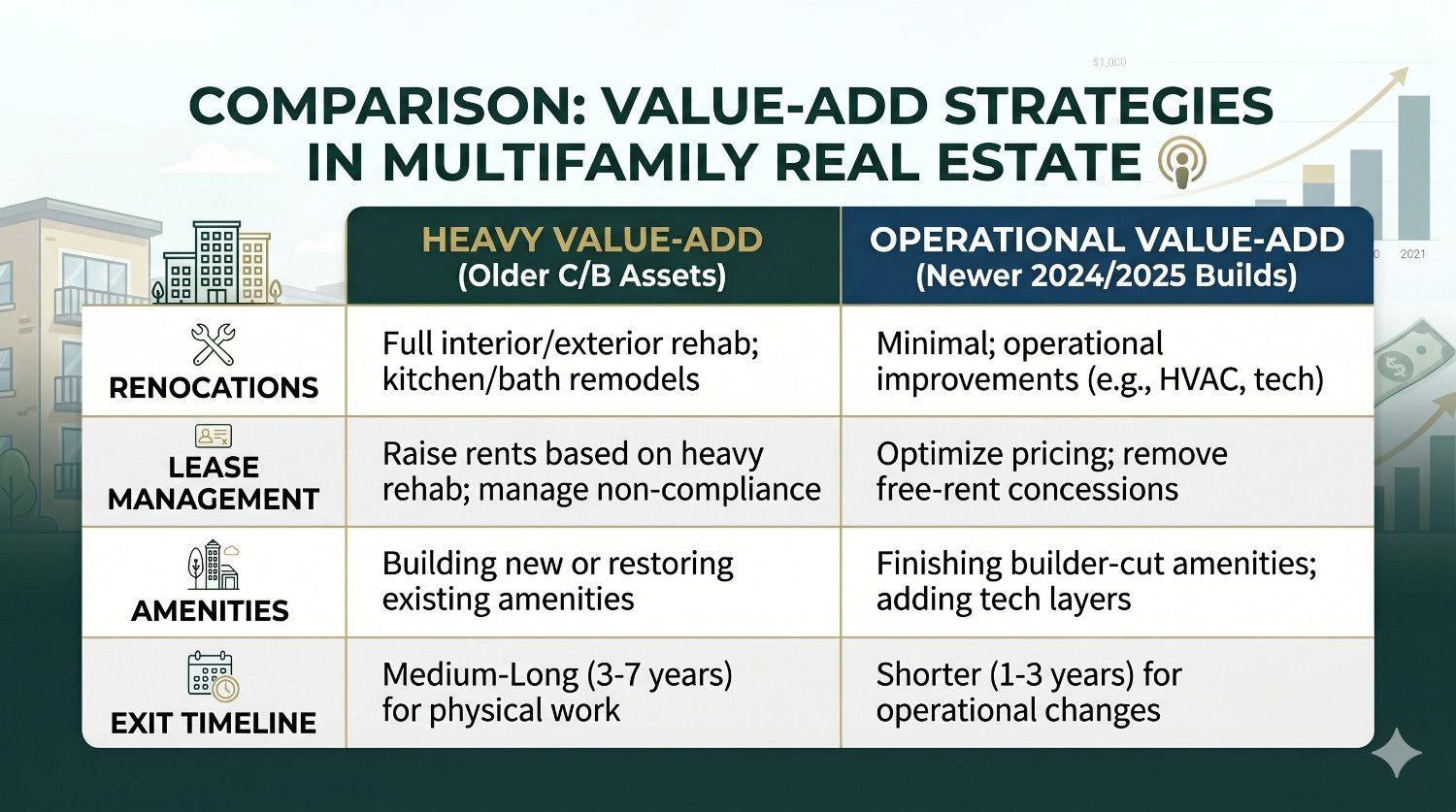
When I asked Ken what counts as "value-add," his answer changed how I think about the strategy entirely. New investors picture blown-out kitchens and gutted bathrooms, and for older C-class properties, that's still part of the playbook. But Ken has evolved past that.
His last two deals were 2024 and 2025 builds. There's almost nothing physical left to renovate. The value now comes from operations: finishing amenities that builders cut to stay on budget, replacing free-rent concessions with real lease pricing, and running the asset the way a long-term owner actually should.
For Ken, value-add multifamily investing isn't a single playbook. It's a discipline of finding the gap between how a property currently performs and how a skilled operator can make it perform, whether that gap is physical, operational, or both.
Why the Neighborhood Decides Every Deal
Ken has a hard rule that every new operator needs tattooed on the inside of their eyelids: don't negotiate the neighborhood. Numbers can lie. Pro formas can be massaged. But a neighborhood is what it is, and you cannot out-renovate it.
"You can't change the neighborhood. You have to buy the whole neighborhood, and it's still hard because it has that reputation. So, the neighborhood is number one on our list because I've learned this lesson over 30 years."
I see new investors get seduced by spreadsheet cash flow on properties in areas that will never support rent growth. Ken's logic is brutally simple: the only way you add value is by making a property nice enough that someone will pay more to live there. If the surrounding area can't support that price point, your renovation budget evaporates into a building no one wants.
Neighborhood selection is the first filter at KRI. Cash flow is the second.
The Real Money Is in Appreciation, Not Cash Flow
Here's the math that should change how you evaluate every multifamily deal. Ken broke this down in a way that finally clicked for me, and I think it'll click for my listeners, too!
If you raise rents enough to add $100,000 of net operating income to a property, the cash flow distribution alone won't change your life. What changes your life is what that NOI does to the property's value. At a 5 cap, every $1 of NOI is worth roughly $20 in property value. A $100K NOI lift can drive roughly $2 million in appreciation.
That's the engine. That's why heavy cash-flow deals in weak neighborhoods often underperform. There's no rent ceiling left to push against, so the appreciation lever is broken before you even close.
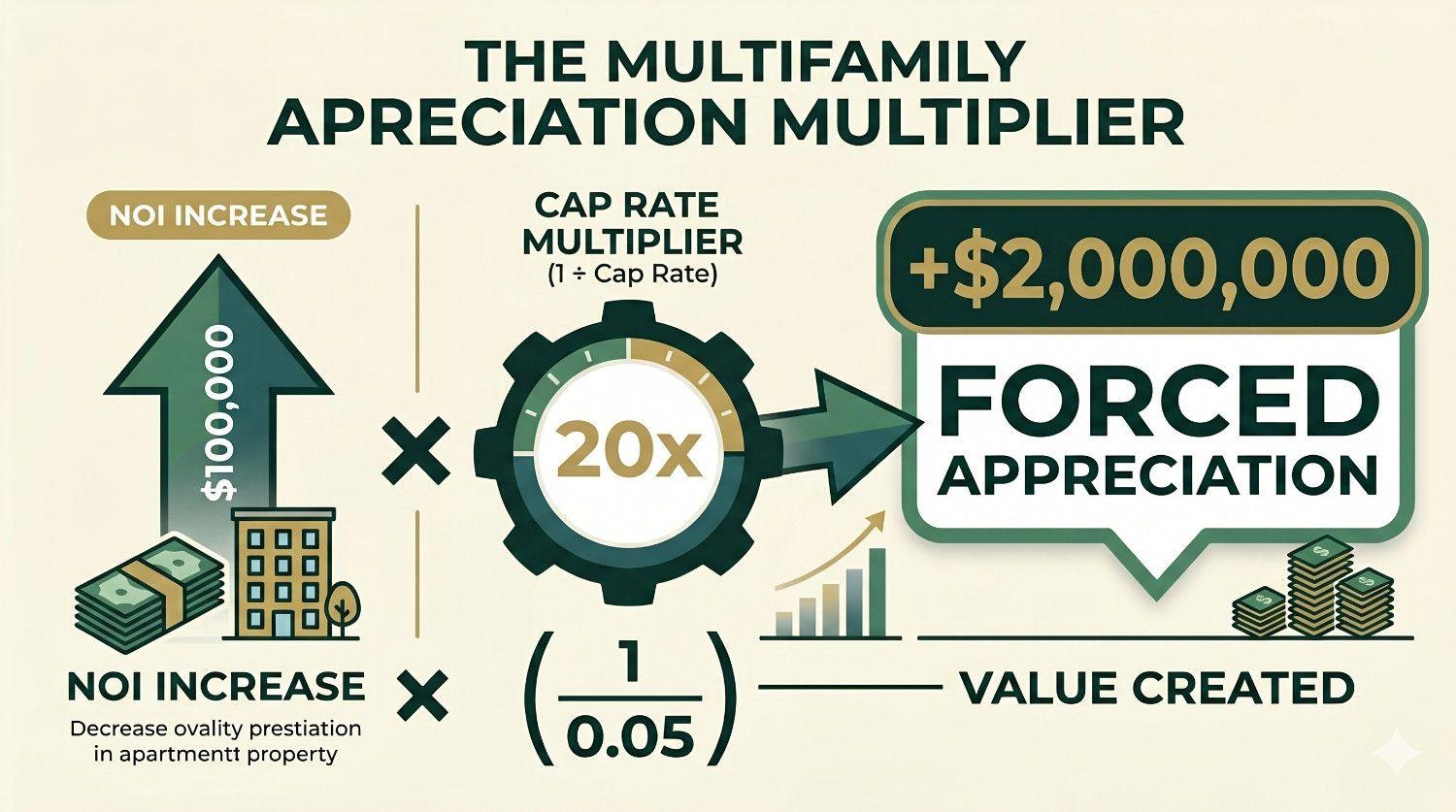
This is also why multifamily appreciation is the wealth engine, not the side benefit. I now look at every deal I underwrite as a value-creation play first, with cash flow as the bridge that funds the hold period.
Bottom-Up Underwriting Is the Operator's Insurance Policy
Ken's CPA background shows up everywhere, but nowhere more than here. He doesn't believe operators have any business raising capital until they can defend every line item in their pro forma from the ground up—payroll, taxes, pest control, insurance, every number.
"I want you to imagine yourself on Shark Tank. I want you to stand there in front of Mr. Wonderful and let him figure out that you really don't know the detailed numbers in your business. It's not going to go well."
The mistake most new syndicators make is borrowing a broker's pro forma, plugging in optimistic rent growth, and calling that underwriting. Investors can sense when you don't actually know your business.
Bottom-up underwriting is non-negotiable at KRI. Operators who want to build that muscle can learn how to underwrite real estate deals through Ken's program, and The KRI Full Cycle Investment System goes further by covering what almost no one teaches: how to actually run the property after you buy it.
What Changed for Me After This Conversation
I came into this episode confident in my own playbook. I left with a clearer hierarchy.
"Cash flow is important, but what's most important is that you're able to add the cash flow so that somebody will pay you more when you're ready to sell it than you paid for it."
That line is the one I keep coming back to. Cash flow isn't the goal but the byproduct of a property positioned for appreciation in a neighborhood that can actually support the rent thesis.
Ken's framework also reinforced why I built real estate investment services around education first. Operators who learn the right way through resources like Ken's multifamily investment academy don't blow up portfolios when the market turns. They scale through it.
For me, this conversation tightened my filters: neighborhood first, bottom-up numbers second, appreciation thesis third, and cash flow as the funding mechanism for the hold.
Want to hear my full conversation with Ken on building multifamily wealth through value-add investing?
Frequently Asked Questions
What does Ken look for in a value-add multifamily deal?
Neighborhood quality first, then a clear gap between current performance and what a skilled operator can deliver, whether that gap is closed through physical renovations on older assets or operational improvements on newer builds.
How does Ken think about cash flow versus appreciation?
He treats appreciation as the real wealth engine. A $100,000 NOI lift at a 5 cap can create roughly $2 million in value, while cash flow is the income that supports the hold period until exit.
Why does Ken stress bottom-up underwriting for new multifamily operators?
Because investors can tell when you don't know your numbers. Knowing every line item—payroll, taxes, insurance, pest control—is what separates a real operator from someone reselling a broker's pro forma.
Apply as a Guest on the Cash Flow Authority Podcast
If you're a high-performing professional or operator who's done the reps in multifamily, capital markets, lending, brokerage, or value-add real estate, I want to hear your story, too! The Cash Flow Authority exists to give my listeners the playbooks, mindset shifts, and operator-level honesty that helped people like Ken Gee of KRI Partners build wealth on their own terms.
The Cash Flow Authority is produced by Icons of Real Estate, the #1 Real Estate Podcast Network. If you are a real estate professional, apply to be a guest speaker across the network!
Disclaimer: The Cash Flow Authority makes no promise or guarantee of any results, money, success, or lifestyle from learning real estate investing strategies. The information provided in this blog is for educational and informational purposes only and should not be considered financial, legal, or professional advice. The views expressed in this blog are those of the author and do not necessarily reflect the official policies or positions of any organization, government agency, or financial institution. Any personal experiences shared are for illustrative purposes only and may not apply to every person's situation. This information is general, not personal. Seek specific advice from a licensed professional for legal, financial, and business decisions. There are no typical results in real estate investing; every person, property, and transaction is unique. The information shared in this blog is believed to be truthful, accurate, legal, moral, and ethical, and is subject to change.