


Inside the 700-Property Exit: How Patrick Southern Turned a REIT Portfolio Into Maximum Value
Selling 700 properties in a single market without crashing your own prices sounds like a problem with no clean answer. Patrick Southern, founder of Properties by Southern, solved it over nearly a decade, moving every unit from a REIT portfolio through individual retail transactions in Jersey City, New Jersey.
When I sat down with him on the Cash Flow Authority podcast, I expected a conversation about brokerage volume. What I walked away with was a sharper understanding of transaction strategy, pricing discipline, and the kind of strategic patience that turns a 700-property portfolio into maximum value per unit. Between Patrick and his team at Properties by Southern, they've closed more than 3,000 transactions across 20-plus years in Hudson County, and the way he thinks about portfolio sales reshaped how I'm approaching my own development projects in Dallas.
The detail I keep coming back to: Patrick wakes up at 4:30 every morning, hits the gym, does ice baths and meditation, then prospects for three straight hours before his first client call. He's been doing that five days a week for two decades. That kind of operational grind is the throughline of everything we covered, from REIT exits to new construction optimization.
Some of the best moments from this conversation landed hard. Watch the highlights below.
For the full story on how Patrick dismantled a 700-unit REIT portfolio, why smaller apartments produce better returns, and what the 2026 market looks like for investors ready to act, the whole episode is here.
That caliber of practitioner insight is what we build around at The Flow Authority. Stay connected with Patrick on LinkedIn and Instagram, and follow our community on Facebook and Instagram for more conversations with professionals doing the work.
My Conversation with Patrick Southern: Real Estate at Scale

Patrick's track record reads like a case study in market specialization. He's closed over 3,000 transactions and runs the largest condo sales operation in Jersey City and Hudson County. He's also the only agent in the area selected by Dixon Advisory USA to reposition and sell their entire REIT portfolio as individual retail assets, overseeing nearly $200 million in sales volume.
He's now partnered with Ryan Serhant for new development across New Jersey, which tells you exactly how the market views his ability to move high-volume inventory without leaving money on the table.
What made this conversation stand apart from a typical broker interview is that Patrick also builds. He's invested his own capital into apartment buildings, land entitlements, new construction rental projects, and self-storage facilities. That firsthand developer experience gives him a perspective most agents can't offer, because he's closed deals on both sides of the table.
What a REIT Really Means for Real Estate Investors
A REIT, or real estate investment trust, is a vehicle that pools investor capital to acquire, manage, and sell real estate for profit. Patrick explained how Dixon Advisory, an Australian company, established a REIT called US Masters in the United States and used it to target distressed homes in Jersey City during the financial collapse.
What separates how a REIT invests in real estate from how an individual buyer operates:
REITs pool capital from multiple investors to acquire assets at scale
The standard cycle is acquisition, stabilization, and exit
Decisions run on timelines, debt structure, and return thresholds
Institutional decision-making strips emotion from the process
That structure is exactly why Dixon could deploy capital into a collapsing market while individual buyers stood frozen on the sidelines.
The 2008 Opportunity: Why Smart Money Moves During Fear
Dixon Advisory entered Jersey City in 2009, right in the teeth of the financial crisis. Patrick described the moment like someone who watched it unfold firsthand:
"Dixon Advisory was an Australian company that established a REIT, a real estate investment trust, tagged as US Masters here in the United States. In 2009, during the collapse of the financial market, they had the insight to come to Jersey City, New Jersey. They started picking up distressed homes between 2009 and 2012. It was a scary time for real estate, but if you had capital to deploy, there were great opportunities. At that time, Jersey City was in an infantile stage of growth compared to where it is today."
Investing in Jersey City real estate in 2009 required conviction most people simply didn't have. The House Price Index for Hudson County shows how sharp the recovery has been since then, confirming that capital deployed during peak fear generated outsized returns.
Turning 700+ Properties Into a Strategic Exit Plan
When Dixon was ready to exit, Patrick was tapped to manage the entire real estate portfolio liquidation strategy. Over 700 properties in one market, all needing to sell without flooding supply and collapsing pricing.
"The idea for this REIT was to get in, amass properties, stabilize them, and then eventually exit. When it was time to exit, I was tapped to help them sell the entire portfolio, which took close to a decade. There were over 700 properties to sell. From a brokerage standpoint, it was professionally challenging to figure out how to whiteboard that many properties in one marketplace without cannibalizing our own sales. We elected to do one-by-one retail transactions rather than bundling them at a discount, and we were very successful with that approach."
That decision to go retail over bulk is where the real value was captured. A discounted bundle sale would've been faster, but it would've left significant money behind.
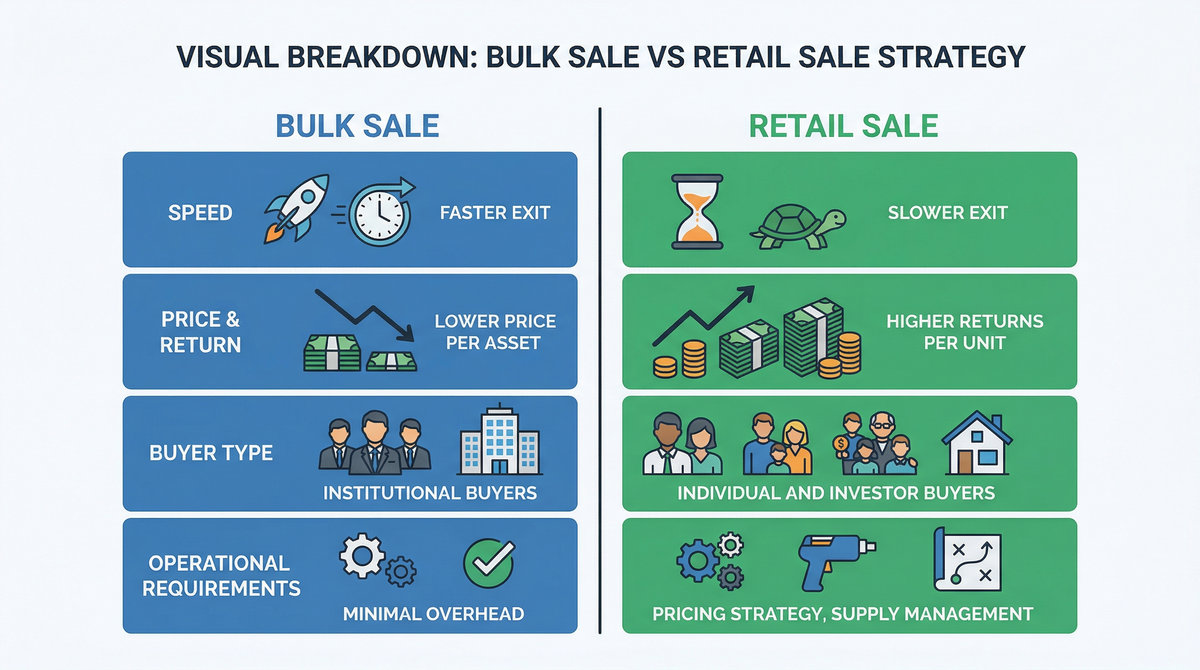
Patrick's team chose the retail path, and the numbers proved it right. He's now down to his last 60 or 70 properties from that original portfolio.
The Challenge of Selling at Scale Without Cannibalizing Value
Managing supply was the hardest part of the Dixon exit. Listing too many properties at once in the same zip code would've created internal competition between Patrick's own listings, dragging prices down across the board.
This required a whiteboard-level operation: staggering listings, calibrating pricing against absorption rates, and holding inventory instead of rushing it to market. For anyone trying to understand how market cycles affect real estate investing, this is the textbook case. Disciplined supply management protected long-term returns even when the temptation was to move fast.
I've encountered a smaller version of this in my own investing journey. When you hold multiple assets in one submarket, every pricing decision on one property ripples into the others. Patrick was managing that balance across hundreds of units, which is a level of operational precision most brokers never face.
Market Cycles and Why Timing Alone Isn't Enough
Dixon didn't get lucky in 2009. They had capital positioned, a thesis on Jersey City's growth trajectory, and the infrastructure to execute at scale. Preparation was the deciding factor.
Patrick brought that same clarity when I asked him about the 2026 market for investors:
"Lending has been really tough recently due to debt coverage ratio limits and the amount of capital needed. For people looking to get into real estate, there are a few buckets: joining a syndication, buying a speculation property, or buying for cash flow. I tell clients I'm not in the business of convincing them to buy; I'm in the business of helping them learn what they want and coming up with a game plan."
"You shouldn't buy anything until you can identify what success looks like to you. If you don't have a plan, you might buy something out of inertia and realize two years later it's a pain in the neck."
Knowing what you want before you write a check is the single most underrated step in real estate. Our coaching program is built around exactly that kind of clarity.
Institutional vs Everyday Investor Thinking
Patrick has operated on both sides of the institutional and retail divide, and that experience gave him a sharp read on where individual buyers fall short. The gap comes down to framework.
Institutional mindset:
Data-driven acquisition criteria
Long-term hold and exit timelines
Portfolio-level risk management
Decisions driven by spreadsheet
Individual mindset:
Deal-by-deal evaluation
Emotional attachment to specific properties
Short-term focus on monthly cash flow
Tendency to buy without an exit strategy
The investors who perform best, in Patrick's view, borrow the institutional framework and apply it at a personal scale.
Why Having Multiple "Buckets" of Deals Matters
Patrick doesn't depend on a single revenue stream. His brokerage, development projects, and personal investments each serve different financial goals. He described how that diversification took shape over time:
"I started by investing my own money back into real estate, buying small apartment buildings, then larger ones, then land for entitlements. Before I knew it, I was building new construction rental projects and self-storage. While real estate sales is my main job, I do these projects for generational wealth. Because I have firsthand experience as a developer, I can relate to my clients better. This is why I partnered with Ryan Serhant for new development in New Jersey."
That kind of layered deal flow protects against any single market segment cooling off. Brokerage income funds daily operations, development builds equity, and investments produce long-term cash flow. When one bucket slows, the others carry the weight.
Lessons From Managing Millions in Real Estate Transactions
Three principles surfaced repeatedly throughout our conversation:
Operational discipline outperforms talent. Patrick's 4:30 AM routine and three-hour daily prospecting block produced 3,000 closings over 20 years. Good luck outworking that schedule.
Strategic patience pays. Selling 700 properties individually instead of bundling for a fast exit generated significantly higher returns across the Dixon portfolio.
Execution compounds. Patrick followed the same prospecting program for two decades. The results weren't built on shortcuts or market timing; they stacked through consistency applied to a proven process.
Key Differences in Real Estate Strategies
Each strategy carries a different risk and return profile, and the right fit depends on your capital, timeline, and investor identity. Patrick's advice is consistent: define what success looks like before you buy anything.
The Future After the Portfolio: What Comes Next
Patrick has roughly 60 to 70 Dixon properties remaining, and he expects to finish those this year. After that, his focus shifts deeper into new construction development, working with builders from concept to closing, maximizing price per square foot with tighter unit optimization and design efficiency.
For investors wondering where to start, Patrick's framing cut through the noise:
"My answer isn't always exciting, but it's accurate: you have to go out and do things, fail, and find out why you failed. Entrepreneurship and sales require constant self-evaluation. There are people stuck in a cycle of 'getting ready to get ready,' but eventually, you just have to start. You shouldn't take all your funds and try to develop a property solo if you've never done it before, but you have to take that first step."
That advice applies whether you're acquiring your first rental or exiting a 700-property REIT portfolio. Market cycles will always shift, but the operators who build a plan and execute against it, the way Patrick Southern runs Properties by Southern, are the ones who keep producing regardless of where the market lands.
Frequently Asked Questions
What is a REIT in real estate?
A REIT (Real Estate Investment Trust) pools investor capital to acquire, manage, and sell real estate assets for profit. Institutional REITs like the one Dixon Advisory operated deploy capital during specific market windows, stabilize their holdings, and exit based on return targets and timelines rather than emotion.
Why sell properties individually instead of in bulk?
Individual sales typically yield higher per-unit returns because you capture retail pricing instead of accepting a discounted bulk rate. The tradeoff is time and operational complexity: Patrick's team needed close to a decade to move through 700-plus units, but that liquidation approach maximized total value across the entire portfolio.
What was unique about the Jersey City investment opportunity?
Jersey City in 2009 was a distressed market with significant upside that most individual investors were too afraid to touch. Dixon Advisory entered during the post-collapse window, acquired properties at below-market prices, and held through a decade of rapid urban growth. That timing, combined with institutional capital and a long-term exit plan, created outsized returns that validated the REIT model.
Apply to Be a Guest on the Cash Flow Authority Podcast
Patrick Southern walked us through what it actually looks like to manage a 700-property REIT exit, build a new construction pipeline, and prospect every single morning for 20 years. That's the kind of conversation we're after on this show: real operators sharing real playbooks.
If you're working in portfolio management, institutional sales, development, or any corner of real estate where the strategy runs deeper than a single flip, we want to hear how you're building. Whether you've managed large-scale liquidations, structured creative exits, or scaled a brokerage through market cycles the way Patrick Southern has built Properties by Southern, there's a seat at the table.
Disclaimer: The Flow Authority makes no promise or guarantee of any results, money, success, or lifestyle from learning real estate investing strategies. The information provided in this blog is for educational and informational purposes only and should not be considered financial, legal, or professional advice. The views expressed in this blog are those of the author and do not necessarily reflect the official policies or positions of any organization, government agency, or financial institution. Any personal experiences shared are for illustrative purposes only and may not apply to every person's situation. This information is general, not personal. Seek specific advice from a licensed professional for legal, financial, and business decisions. There are no typical results in real estate investing; every person, property, and transaction is unique. The information shared in this blog is believed to be truthful, accurate, legal, moral, and ethical, and is subject to change.