


Rick Albert on House Hacking & Scaling Rentals

Rick Albert bought a condo in 2015 that most buyers wouldn't walk into. The previous owner had been a heavy smoker for over 30 years, and the smell hit you from the sidewalk. Rick, host of the Key to the City of Angels podcast and a full-time Los Angeles broker associate, recognized a cosmetic problem where everyone else saw a deal-breaker.
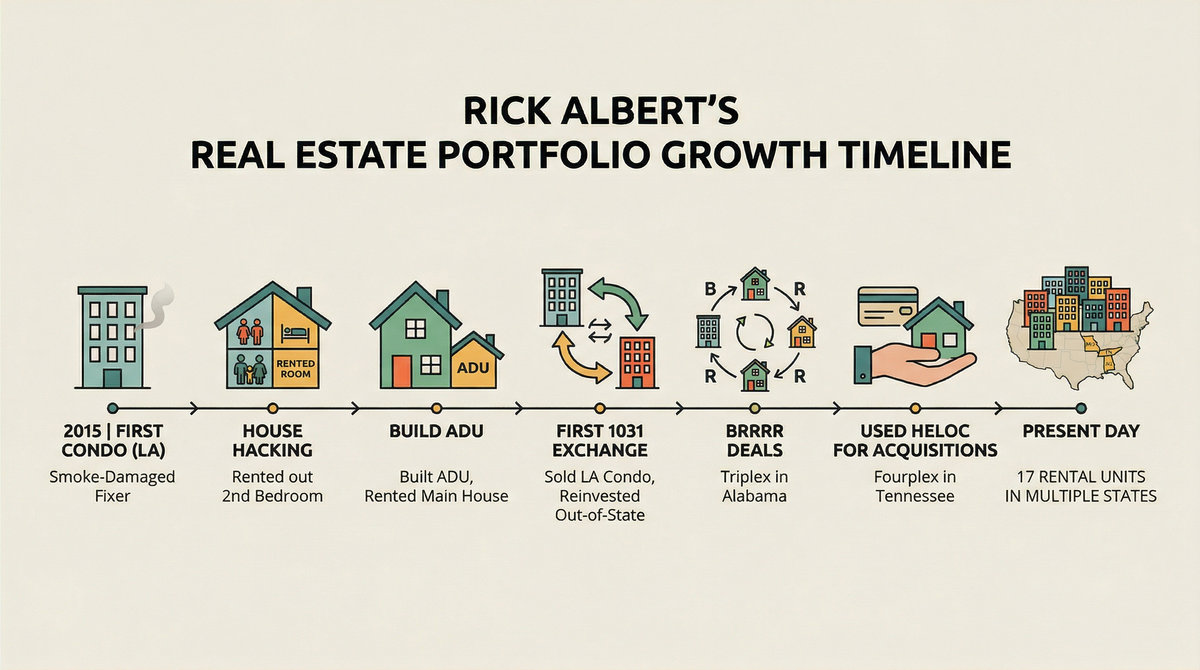
His background buying foreclosures at the courthouse steps and managing rehab projects had trained him to separate fixable problems from structural ones. That single condo became the first move in a portfolio that now includes 17 rental units across Tennessee, Alabama, and Missouri.
I sat down with Rick on a recent episode of Cash Flow Authority to pull apart the mechanics behind his scaling strategy. His path mirrors a lot of what I teach through my own real estate investing coaching: house hacking early, leveraging equity aggressively, and deploying capital into out-of-state markets where the math actually works.
What stood out was how candid Rick was about the friction points: the 1031 that almost fell apart, the war zone property he had to walk away from, and the vacancy patterns he's watching in real time.
For the full conversation covering Rick's play-by-play on HELOCs, BRRRR, 1031 exchanges, and what he'd do differently starting today, the entire episode is here.
Rick Albert shares the actual numbers and the setbacks — exactly the kind of investor this show was built for. Follow his work on Instagram, Facebook, and YouTube.
How a Smoke-Damaged Condo Launched a Multi-State Portfolio

Rick's background gave him a serious edge. Right out of college, he was buying foreclosures at the courthouse steps. He then moved into project management for a local developer, where he learned to read renovation budgets and spot the difference between structural damage and surface-level problems. When he found that condo, he knew the smoke damage could be fixed without ripping out drywall.
"When everyone was saying 'don't buy, we're still in a recession,' I decided I was going to buy. I bought my first condo here in LA. It was a heavy fixer by condo standards. The owner at the time had been a heavy smoker there for over 30 years. You could smell the smoke from outside. Most people were passing on it, but I knew it could be fixed."
He fixed the unit, rented out the second bedroom, and kept that house hacking setup going for a few years before leveraging the equity to buy a second property with his fiancée. They built an ADU (Accessory Dwelling Unit), lived in it, and rented out the main house because they needed the larger rental income to cover costs. From there, Rick started chaining 1031 exchanges and pulling lines of credit to fund the next acquisition. Each property bankrolled the one after it.
My first buy was a condo too, though I didn't house hack it right away. I converted it to a rental later and looked at duplexes in the LA/Orange County area where I'd live in the back unit and rent the front. The principle is the same: get in, reduce your housing cost, and use the position to build.
Why HELOCs Beat Saving for the Next Property
Rick said something I tell my own coaching clients constantly: real estate only wins when you leverage it.
"Real estate only makes sense if you leverage it. Otherwise, you're probably better off investing in the stock market where returns are similar and you don't have to deal with tenants. But with real estate, the appreciation is on the asset, not the loan amount. Anytime you can leverage what you have to buy more properties, that's a better use of that money."
Most people associate Home Equity Lines of Credit with renovations or personal expenses. Rick uses them as acquisition tools. He and his business partner pulled a line of credit on an existing property and bought a fourplex in Tennessee with cash — the kind of speed and cash-offer advantage that wins in competitive markets.
For veterans, I'll share my own playbook. I got my HELOC through Navy Federal's 95% loan-to-value program with a 20-year draw. I've recycled that line multiple times. The broader trend supports this approach: roughly 85% of conventional refinance originations in the first half of 2024 were cash-out refinances, pulling equity out of existing properties to deploy elsewhere. Equity-based strategies aren't niche anymore.
Key advantages of using a HELOC for investment acquisitions:
Access equity without selling the underlying property
Interest-only payment options keep carrying costs low during the acquisition phase
Cash offers remove financing contingencies, making your bid stronger against competing buyers
The line is repeatable: pay it down, draw again for the next deal
The BRRRR Method Works Best Outside High-Cost Markets
In 2022, Rick sold his LA condo after a long-term tenant moved out. The COVID-era eviction moratorium in Los Angeles meant that even a vetted tenant could stop paying rent with no recourse for the landlord. His wife and business partner weren't willing to carry that risk again.
They deployed the equity into two simultaneous acquisitions: a fourplex in Tennessee (purchased with cash through a partner's line of credit) and a triplex in Birmingham, Alabama, using the BRRRR method — buy, rehab, rent, refinance, repeat.
I ran the same play once in Wisconsin. The rehab phase was a nightmare (bad contractors will teach you patience), but once the property was refinanced and cash-flowing, the numbers proved the model. BRRRR works in the Midwest and Southeast, where purchase prices leave enough spread between rehab cost and after-repair value to recover your capital on the refinance.
Rick explained why that same strategy falls apart in LA:
"Most of my 'fixer' listings sell for 10% to 15% more on the open market because end-users are looking to buy them. It's hard to tell a seller to sell to a flipper for less than what the open market offers. Also, with ADUs, I've seen appraisals give $100,000 in value for a unit that costs $150,000 to build."
That appraisal gap kills the refinance step. If you can't pull your capital back out, the "repeat" in BRRRR doesn't happen. Investing in out-of-state rentals solves this by placing you in markets where the gap between renovation cost and appraised value still allows a full or near-full capital recovery.
The Property Manager Test and the Reality of War Zones
Rick's out-of-state portfolio is producing, but he's honest about the friction. His Nashville fourplex runs on cruise control with small units (625 square feet, two bedrooms) positioned as the affordable option. A new acquisition in Clarksville is mid-rehab. Alabama has delivered solid returns, though vacancies are stretching longer recently.
The real warning centers on low-price-point markets that look incredible on a spreadsheet:
"Alabama has done well, though vacancies are taking a bit longer to fill currently. In low price point markets, you have to watch out for 'war zones.' On paper, the cash flow looks great, but you deal with broken windows, stolen AC units, and high turnover. You need the right team."
I've lived this. I own a five-unit in a rough area of Milwaukee where I inherited four tenants and had to evict three. Crime and repairs eat margins fast. Rick offered what might be the best screening tool for out-of-state deals: "One of the best things about property managers is: if they won't manage it, don't buy it." He learned this firsthand while evaluating 10-unit buildings in Alabama during a 1031 exchange — no property manager would take them, so he pivoted.
Scaling a rental portfolio only holds up when the team on the ground is reliable. If the property manager passes, the spreadsheet doesn't matter.
1031 Exchanges: Start Looking Before You Sell
Rick has executed multiple 1031 exchanges, and his number-one piece of advice is to start early. A Section 1031 like-kind exchange allows investors to defer capital gains taxes when selling one investment property and reinvesting the proceeds into another. The catch is the timeline: 45 days to identify a replacement property, 180 days to close.
"It takes planning. If you wait until your property sells to start looking, you're too late. On my first 1031, I was looking at 10-unit buildings in Alabama, but then I found out no property manager would take them because of the location. I had to pivot quickly. You should start analyzing and even writing offers contingent on your sale before you even close on your current property. You have 45 days to identify and 180 days to close."
That exchange timeline turns into a liability when sellers know you're on the clock — a point Grant Cardone has made publicly, and one Rick agrees with. He also mentioned reverse 1031 exchanges, where you buy the replacement first. The legal fees jump from roughly $1,500 to $9,000, but in markets like LA, that's a small percentage of the deal and removes the deadline pressure.
Tips for executing a 1031 exchange successfully:
Begin property searches before your current sale closes
Write offers contingent on your sale to stay ahead of the 45-day identification window
Have backup properties identified in case your first choice falls through
Consider a reverse 1031 if the added legal cost is a small fraction of the deal size
Lease Details and House Hacking Expectations
Rick sees two recurring patterns among new investors: inflated expectations about house hacking returns and incomplete leases.
On the house hacking side, the mistake is expecting to live for free on day one. With 3.5% down, the monthly payment rarely gets fully covered by rental income immediately. The real returns arrive through tax benefits, loan pay-down, and appreciation over time. Rick's perspective is straightforward — all of those returns still beat renting, even if the monthly cash flow starts negative.
On leases, Rick finds that landlords frequently skip the general operating rules: quiet hours, laundry schedules, and pet guidelines. In California, landlords can't refuse emotional support animals, so Rick builds pet guidelines into every lease upfront, covering cleanup responsibilities and designated areas. The goal is to set expectations before conflicts arise, especially when multiple tenants share a property.
If you're building toward your first cash-flowing rental, the 90-Day Cash Flow Accelerator walks you through deal analysis, financing, and systems setup. For investors looking to scale into multi-unit properties, understanding how commercial lending works at the multifamily level is the next step.
The Long View on Real Estate
Rick shares my conviction: time is the most powerful variable in real estate. Market crashes are paper losses for investors who hold. He put it plainly during our conversation: if you bought a property the day before the 2008 crash and held, you'd be in great shape today. Everyone needs a roof, and that demand doesn't evaporate. Even if a structure burns down, land value and insurance provide a floor.
My own portfolio tells the same story. Going from a single condo to over a dozen rental units taught me that investors who panic during downturns fund the deals of investors who hold. I'm selling a condo in California right now because I'm relocating to Texas, and after only a year and a half of ownership, I'm coming out of pocket at close.
Rick's advice: there's nothing wrong with renting if you aren't ready to commit. Buying short-term and expecting long-term results is where most people go wrong.
With median mortgage payments sitting at roughly $1,500 per month nationally and significantly higher in coastal markets, house hacking remains one of the strongest paths into ownership for anyone willing to sacrifice some comfort early on.
Frequently Asked Questions
What is house hacking and how does it help with real estate investing?
House hacking means buying a property, living in part of it, and renting the rest to offset your mortgage. Rick's first house hack involved renting out a second bedroom in his condo. For his second, he built an ADU, lived in it, and rented the main house. The approach pairs best with low down payment loans (FHA at 3.5% or VA at 0%). Returns come through tax benefits, appreciation, and loan pay-down rather than immediate cash flow.
Is the BRRRR strategy effective in 2025?
It depends on the market. Rick and I both found success with BRRRR in the Southeast and Midwest, where purchase prices leave enough margin between rehab cost and after-repair value to recover capital on the refinance. In high-cost markets like LA, appraisal gaps on ADUs often prevent full capital recovery, breaking the "repeat" cycle.
How do you find reliable property managers for out-of-state investments?
Rick uses local realtors as a starting filter. He always asks them "Would you buy here?" He's worked with the same agents across Alabama, Tennessee, and St. Louis for repeat deals. His rule: if a property manager won't take a property, don't buy it. Build those relationships before you start sending offers.
Apply to Be a Guest on the Cash Flow Authority Podcast
Rick walked us through the full arc — from a smoke-damaged condo to 17 units across three states, including the 1031 that nearly fell apart and the war zone properties he learned to walk away from. That's the kind of conversation this show is built for.
If you're house hacking your first deal, scaling into out-of-state markets, running BRRRR rehabs, or figuring out how to pull equity and redeploy it, I want to hear how you're doing it. The best episodes come from investors who are in the middle of it and willing to share what's actually working.
Disclaimer: The Flow Authority makes no promise or guarantee of any results, money, success, or lifestyle from learning real estate investing strategies. The information provided in this blog is for educational and informational purposes only and should not be considered financial, legal, or professional advice. The views expressed in this blog are those of the author and do not necessarily reflect the official policies or positions of any organization, government agency, or financial institution. Any personal experiences shared are for illustrative purposes only and may not apply to every person's situation. This information is general, not personal. Seek specific advice from a licensed professional for legal, financial, and business decisions. There are no typical results in real estate investing; every person, property, and transaction is unique. The information shared in this blog is believed to be truthful, accurate, legal, moral, and ethical, and is subject to change.