


Andrew Postell on the BRRRR Method for Building Long-Term Wealth in Real Estate Investing
Andrew’s first BRRRR story didn’t sound polished, and that’s exactly why I trusted it. On this episode of Cash Flow Authority, I sat down with Andrew Postell, a Marine Corps veteran, longtime investor, top 1% loan officer, and self-made millionaire, and the most useful part of the conversation had nothing to do with glamour. Andrew Postell BRRRR real estate investing is built on ugly houses, patient underwriting, and the willingness to keep moving after a deal barely pencils.
What stayed with me was how often Andrew pulled the conversation back to basics people try to skip. Buy your own home first. Learn to house hack. Build a real network before you chase a hotter market. He went from a $7,000 property and hard lessons on rehab spread to millionaire-level wealth without pretending the road was clean.
If you want the full conversation, including the Marine-to-Marine talk on discipline, the BRRRR framework, and why one property a year still matters, the full episode belongs right here.
Where to keep up with Andrew after this conversation:
More from me and the show:
From the Marine Corps to Real Estate - Andrew Postell’s Origin Story

When he explained what the Marines added, I recognized the tone immediately. Marines don’t get to wait for perfect clarity. They learn to move, learn, and keep pressure on the problem.
“It’s impossible to say there was nothing that influenced me from the Marines. Of course it did. It’s the intangible things, the discipline of it. You will not fail when you do it. There’s an analytical piece of it too, but not too analytical. The more you wait, the more you delay.”
That combination, discipline with a hard cap on overthinking, is what separates a real investing operating system from motivational content. It’s also why I keep pushing people toward a tighter ninety-day plan for turning income into actual acquisition momentum instead of letting another quarter disappear in “research.”
Why Your First Investment Should Be Your Own Home
Andrew was definitive here, and beginners need that. The industry trains people to think the first smart move is a clever rental. He pushed toward the first deal where the system is designed to protect you.
“I’m going to be very definitive about what I’m going to say here. I want people to focus on their own primary home. It’s so difficult to be a homeowner these days. Only 4% of Americans own two homes. We’re in real estate, so we think everybody does it, but not everybody does. Very few people have two or three.”
He’s right. A primary residence comes with agents, inspections, financing rules, and a home-inspection process that slows you down before you make an expensive mistake. Distressed investment deals punish beginners fast.
What Andrew is protecting beginners from:
mistaking access for skill
waiving safeguards before they know how to price risk
chasing status through an “investment property” while their own housing stays unstable
House Hacking - The Most Accessible Entry Point for New Investors
House hacking gets talked about like a tactic. Andrew talked about it like a lived season of life, and that difference matters. Your first deal can teach you how to think like an operator without throwing you straight into a capital-intensive rehab.
“There was a financial thing there, but the intangible piece is where I have the memories of that home. My friends to this day are lifelong friends. They remember that house on Globe. It was a terrible home made out of cinder blocks, but the memories were great. House hacking for me helped my friends and I absolutely had a financial benefit from it.”
If I were starting over, I’d take the same path. You reduce your housing cost, learn how other people live inside an asset you own, and start seeing cash flow as behavior instead of theory. I’ve already laid out a live-in rental path that keeps expenses down while you learn the business up close, and Andrew’s story is the human version of that playbook.
Why house hacking stays underrated:
it lowers the tuition on your first real estate lesson
it forces you to care about operations, not just appreciation
it teaches ownership while the stakes are still manageable
What Is the BRRRR Method in Real Estate Investing?
What makes Andrew Postell BRRRR real estate investing worth studying is how unromantic it is. He found BRRRR because he didn’t have enough capital to wait for cleaner deals.
“Then I have to bid an unreasonable, low price where it’s offensive. You have to make a profit. Sometimes to make a profit, you’ve got to get a little crazy on the price. I make about 100 offers a year and I do two. That’s how hard it is. But doing that has made me a millionaire.”
That’s the part people skip when they talk about the brrrr method real estate investing online. The refinance is not the magic. The margin is. If you don’t buy at a number that gives the deal room to survive rehab surprises, you’re borrowing confidence from the future.
That is why I keep paying attention to conversations about scaling rentals without letting leverage pretend to be skill. The structure matters, but the buy price still does the heavy lifting.
How to Find Off-Market Real Estate Deals Through Wholesaler Networks
People love to imagine off market real estate deals as some hidden back channel. Andrew described something far simpler: repeated attendance, list maintenance, and the discipline to offer only where his numbers make sense.
“My network is very important. I go to as many real estate investor meetings as I can. In these networking groups, I look for wholesalers. I’ve got this huge list of wholesalers. People fall off, so you have to add more back into it. I get about 80 to 90 properties a week.”
If you’re serious about how to find off market real estate deals, that answer should calm you down. There isn’t a secret app. There is a local reputation, a list that needs tending, and the willingness to keep making offers after most people get bored.
Andrew’s sourcing rules stayed simple:
meet wholesalers in person
keep rebuilding the list as people disappear
offer only inside your target area
inspect the property yourself whenever possible
ignore the seller’s fantasy price and stick to your own numbers
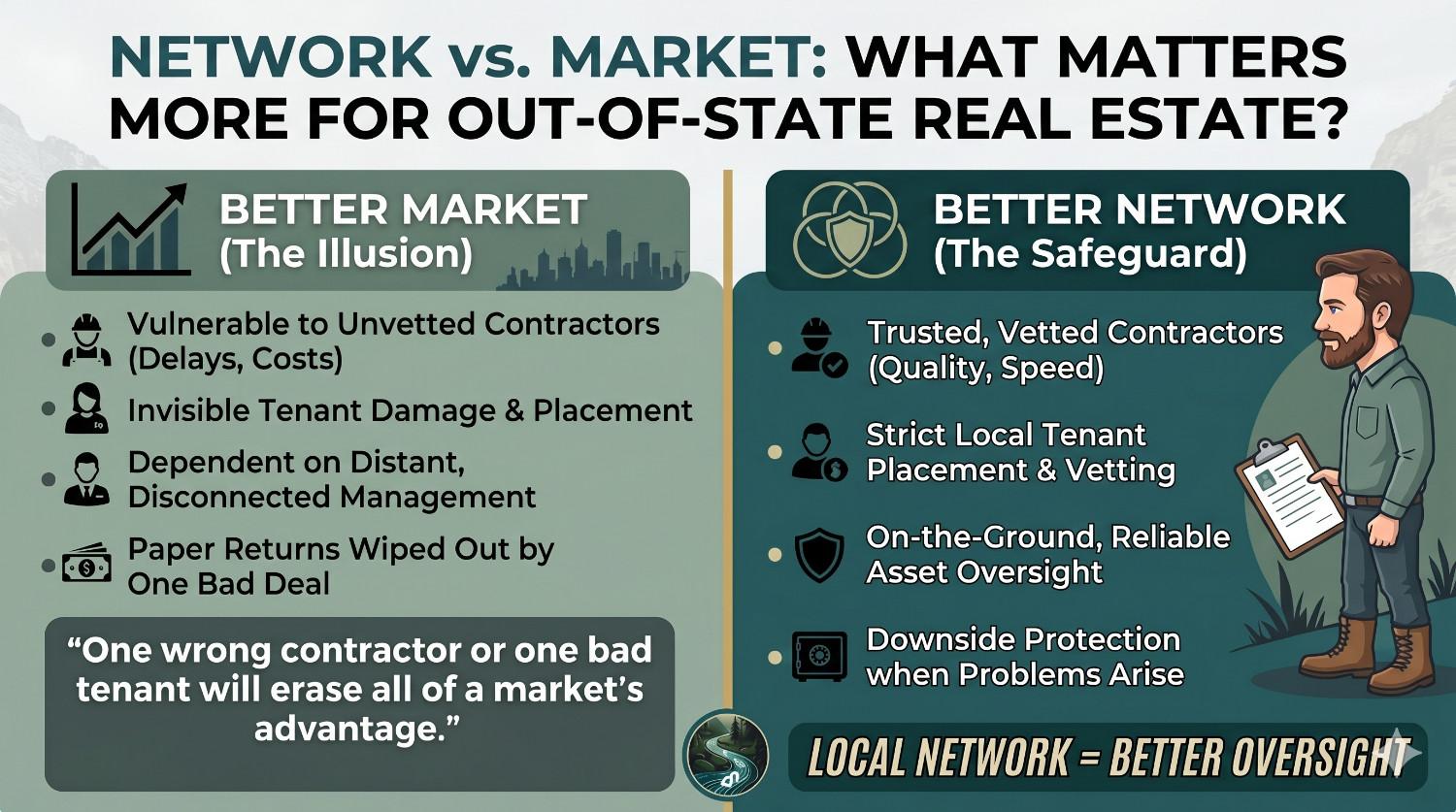
Out-of-State Investing - Why Your Network Matters More Than the Market
Andrew spent fifteen years investing out of state, and he didn’t sell that life as a hack. He sold it as a network problem.
“I’m a 15-year out-of-state investor. I lived in New York City, so you can’t buy real estate there unless you’re really wealthy. For the longest time, I held properties in Jacksonville, Florida. The reason why was because I had a network of people already there that could watch my asset and recommend people for me. When you’re an out-of-state investor, your network is more important than whatever city has one or two percentage points better performance. One wrong contractor or one bad tenant will erase all of that advantage.”
That line should be printed out and taped above a lot of investor desks. A market with slightly better appreciation doesn’t help when your contractor vanishes or your tenant placement goes sideways. Andrew eventually sold those Florida assets through a 1031 exchange into a new set of holdings and consolidated in Dallas-Fort Worth.
Owner Financing and Creative Exit Strategies That Build Cash Flow
This part of the conversation matters because too many investors talk about acquisition as if the exit will sort itself out later. Andrew’s early deals taught the opposite lesson.
“It took me a long time to get to where I am now. When I first got started, my first BRRRR property I bought for $7,000. I knew that if I made a mistake, at least it’d be a small mistake. I put $23,000 of rehab into it, and after it was all done, it was worth $30,000. I didn’t understand the relationship between the value and the rehab then. My next one I bought for $23,000 and put $7,000 of repair into it, and then it was worth $30,000.”
He later told me he owner-financed those properties when he sold them, and that fits the broader point. Notes, seller financing, and lease-option structures widen the number of workable exits when the deal no longer wants to behave like a textbook rental.
The sequence I’m using on my current deal is straightforward:
Buy far below stabilized value.
Prove the new value with the rehab and appraisal.
Use a twelve-month lease option to test payment behavior.
Convert to a land contract once the buyer has earned that longer runway.
The Slow Burn - Why Buying One Property a Year Can Make You Wealthy
This was the cleanest pushback Andrew gave all episode. Too many investors are trying to look scaled before they are durable. He kept dragging the timeline back to something a grown adult can actually live with.
“My uncle retired with seven homes. That’s it. Seven paid-off, cash-flowing homes. He’s fine. His family is fine. Let’s just be fine, and then we can get crazy later if you want to.”
That is the thread running through Andrew Postell BRRRR real estate investing: buy with patience, hold longer than your emotions want to, and let ordinary repetition beat performance. I made a similar call in my own life when I decided I’d rather direct money toward assets I can understand than hand everything over to a retirement account I don’t control.
Andrew also said something else people need to hear: fear doesn’t disappear because you watched more content. You still have to show up at the meetup, walk the property, make the offer, and survive the first hard deal.
Key Takeaways
Andrew’s framework sounds simple because it is simple. Start with the house you live in. Use house hacking to learn ownership while lowering your own cost structure. Move into BRRRR only when you can price ugly properties honestly and hold long enough for time to do its part.
I also liked how little ego there was in his version of scale. He makes a huge number of offers and closes very few of them. He stayed in one out-of-state market because he trusted the people there. He points to an uncle with seven paid-off homes as a better model than a guy trying to flex fifty purchases in a week.
Frequently Asked Questions
What is the BRRRR method in real estate?
The BRRRR method stands for Buy, Rehab, Rent, Refinance, Repeat. Andrew uses it to solve a capital problem, which is how to keep acquiring property when you don’t have enough cash to buy clean rentals one by one. If the buy price leaves no room for mistakes, the method breaks down fast.
How do you find off-market real estate deals?
Andrew builds those opportunities through wholesaler relationships and local investor meetings, not through some mystery shortcut. He said he gets eighty to ninety properties a week because he keeps rebuilding that network. He still filters everything through his target area and his own numbers. He also insists on seeing local properties in person before making an offer.
Is house hacking a good way to start investing in real estate?
Yes, especially for someone who needs reps more than sophistication. House hacking lowers your housing cost while teaching you how people, repairs, and rent all behave inside the same asset. I like it because the first lesson happens on a property you already have reason to care for.
Should I invest in real estate out of state?
You can, but Andrew’s experience makes the tradeoff clear. A better market on paper loses its advantage quickly when you don’t trust the contractor, the tenant placement, or the person watching the property. Out-of-state investing works best when you already have a dependable network there. If you don’t, local investing usually gives you a better shot at controlling your downside.
How many properties do you need to retire on real estate income?
Andrew’s family example is the right answer here: fewer than the internet keeps telling you. His uncle retired with seven paid-off homes and created a stable life from steady cash flow, not spectacle. That doesn’t mean every investor’s number is seven. It means the path to enough is usually shorter than social media suggests.
How can I connect with Andrew Postell?
The cleanest place to start is Andrew’s page at CrossCountry Mortgage. It gives you a direct professional home base if you want to reach out about lending, investing, or his market. I listed the rest of his channels in the intro so you can choose the platform you already use. Reach out to people who have enough scar tissue to answer in specifics.
Apply to Be a Guest on the Cash Flow Authority Podcast
What made this episode work is that Andrew didn’t sell a fantasy. He brought a Marine’s bias for action, an investor’s tolerance for ugly assets, and a long-view argument for buying well and holding longer.
If your own experience lives in that same territory, lending, brokerage, construction, development, property management, tax strategy, or another corner of real estate where real operators still solve real problems, I want to hear it. The people who belong on this show are the ones who can explain what actually happens after the spreadsheet, which is why Andrew Postell BRRRR real estate investing fit this episode so well.