


Michael Abraham on Luxury Real Estate Investing in Los Angeles

Michael Abraham evaluates every deal the same way. He finds the standout property in a given neighborhood and works backward from there. I sat down with him on the Cash Flow Authority podcast, and the framework he laid out, which he calls “flight to quality,” reshaped how I think about property selection. Michael is a luxury real estate agent with Compass and co-founder of the AMRE Real Estate Group, operating across the Los Angeles market. He’s also a licensed architect with a master’s from Pratt Institute, and that design-driven lens informs everything he touches in the greater LA area.
I’m a civil engineer by training and a numbers-first investor by habit. Michael challenged that. His approach to deal selection in LA, his renovation philosophy, and his conviction that cheap materials cost more in the long run all had the precision of someone who’s been hands-on in rent-controlled markets for years. This conversation pushed more of my defaults than I expected.
We pulled a few standout moments from this one. Watch the clips below before you read on.
For the full conversation, including every tangent on LA policy, renovation math, and why Michael can’t find a single downside to the LA duplex play, the whole episode is here.
Michael is the type of practitioner we build episodes around at The Flow Authority.
Stay connected and follow the conversations we’re having with guests like him: LinkedIn | Instagram | Facebook | YouTube | X | Spotify.
Connect with Michael directly on LinkedIn, Instagram, Facebook, and YouTube.
From Architecture to Real Estate — How Michael Abraham’s Design Background Shapes Every Deal

He practiced architecture after earning his master’s from Pratt, then spent years in LA running marketing and design for a tech company during the “Silicon Beach” era. When that company was acquired, he pivoted to buying duplexes and went full-time into brokerage and investing.
That architectural training is his edge. He reads the space itself, evaluating how it functions, how it feels, and where the repositioning upside is.
“I went to school for architecture and practiced for a number of years. I liked it, but I didn’t love it.”
“When that company was acquired, I started buying duplexes and multifamily in LA. Then I decided to go full-time as a realtor and investor. Eventually, I hope to be a developer. The delineation I see is that a developer really does something ground-up, taking a piece of dirt to a building. I’m not quite there yet.”
The Flight to Quality Framework — Finding Hidden Value in Undervalued Neighborhoods
When Michael Abraham evaluates luxury real estate in Los Angeles, everything filters through what he calls “flight to quality.” That means owning the standout property in a given neighborhood, attracting tenants who over-index in income, and capturing premium rents without paying premium prices.
His criteria for identifying these opportunities:
Adjacent to Main Street: Near high-demand hubs without the premium price tag
Permanent demand anchors: Universities, hospitals, and major employers that aren’t relocating
Standout features: Architectural interest, outdoor space, pet-friendliness
Hyperlocal due diligence: In LA, one street can separate a strong investment from a mediocre one
“I believe in a concept called ‘flight to quality.’ I want to buy properties that stand out, whether they’re architecturally interesting, provide outdoor space, or accommodate pets. I want the best in that neighborhood, not necessarily the best neighborhood. I want to feel like it’s an appreciating market and look for accessibility to permanent amenities, universities or large hospitals. Then, ultimately, go hyperlocal. Especially in Los Angeles, one street over can be a radical difference in the living experience.”
Reading the Deal — What Signals Long-Term Upside Beyond the Listing Sheet
Michael stressed that the best deals come from asymmetric information, the kind public platforms don’t surface. His team picks up the phone, talks to agents, and understands the seller’s situation before writing an offer.
He breaks seller motivation into three factors most buyers overlook:
Michael focuses on speed and certainty signals. That’s where the real negotiating leverage lives, and most buyers miss both entirely.
Value-Add Renovation Strategy — The Cap Rate Math That Makes It Pencil
The average building in LA is 60 years old, and many duplexes are over 100. Michael approaches value-add multifamily investing by treating this aged inventory as opportunity, because every incremental dollar of rent increase drives exponential property value growth through cap rate compression.
Renovation costs in Los Angeles run between $700 and $800 per square foot. That number stops most out-of-state investors cold, but Michael focuses exclusively on high-impact upgrades that move the rent needle.
“Renovation costs in Los Angeles are between $700 and $800 per square foot. It’s a lot. But we look at it from a cap rate analysis perspective. For every incremental dollar you increase rent, the value of that property goes up exponentially. The big things are: a new coat of paint, bringing hardwood floors back to life, a nice kitchen, the heart of the home, and clean bathrooms. You don’t need to gut everything unless the market demands it.”
The Materials Rule — Why Cheap Costs More in the Long Run
I learned this on my first renovation. I trusted the contractor on materials and paid no attention to what went in. The tenants destroyed half of it because it felt disposable. When I invested in quality the second time, it finally appraised for what I’d expected.
Michael confirmed what I’d already learned at my own expense.
“Do not use the cheapest materials. Do not let your contractor pick out the flooring. The difference might only be 10% more, but we all know what cheap feels like. Quality feels different. My rule is: don’t do builder grade; do one step above. If you don’t know how to pick, talk to a designer. People care if the floor is cheap linoleum. If you treat the home with respect, the tenants will too.”
Navigating Tenant Buyouts and Repositioning in Rent-Controlled LA
LA’s rent control laws mean you can’t raise rents to market rate overnight. Michael’s approach is straightforward: offer below-market tenants a cash buyout to relocate, and accept their answer either way.
The outcomes are human and unpredictable. Some tenants used the money to change their lives completely. Others stayed put because they couldn’t find anything comparable. I come from the Midwest, where I handle transitions more directly. Michael’s approach within these constraints gave me a different read on tenant relations.
“You’re paying significantly below market. We’re prepared to give you X amount of money to move, would you take it? We had one tenant who bought a tow truck and changed his life with that money. Another was starting a restaurant and was happy to get the cash to move closer to his location. Others say no because they can’t find anything as good.”
The Case for LA — Why Michael Sees an Inflection Point Despite the Challenges
I invest in Orange County and out of state for cash flow because LA’s regulatory environment has always scared me. Michael acknowledged every concern I raised and then made his case anyway.
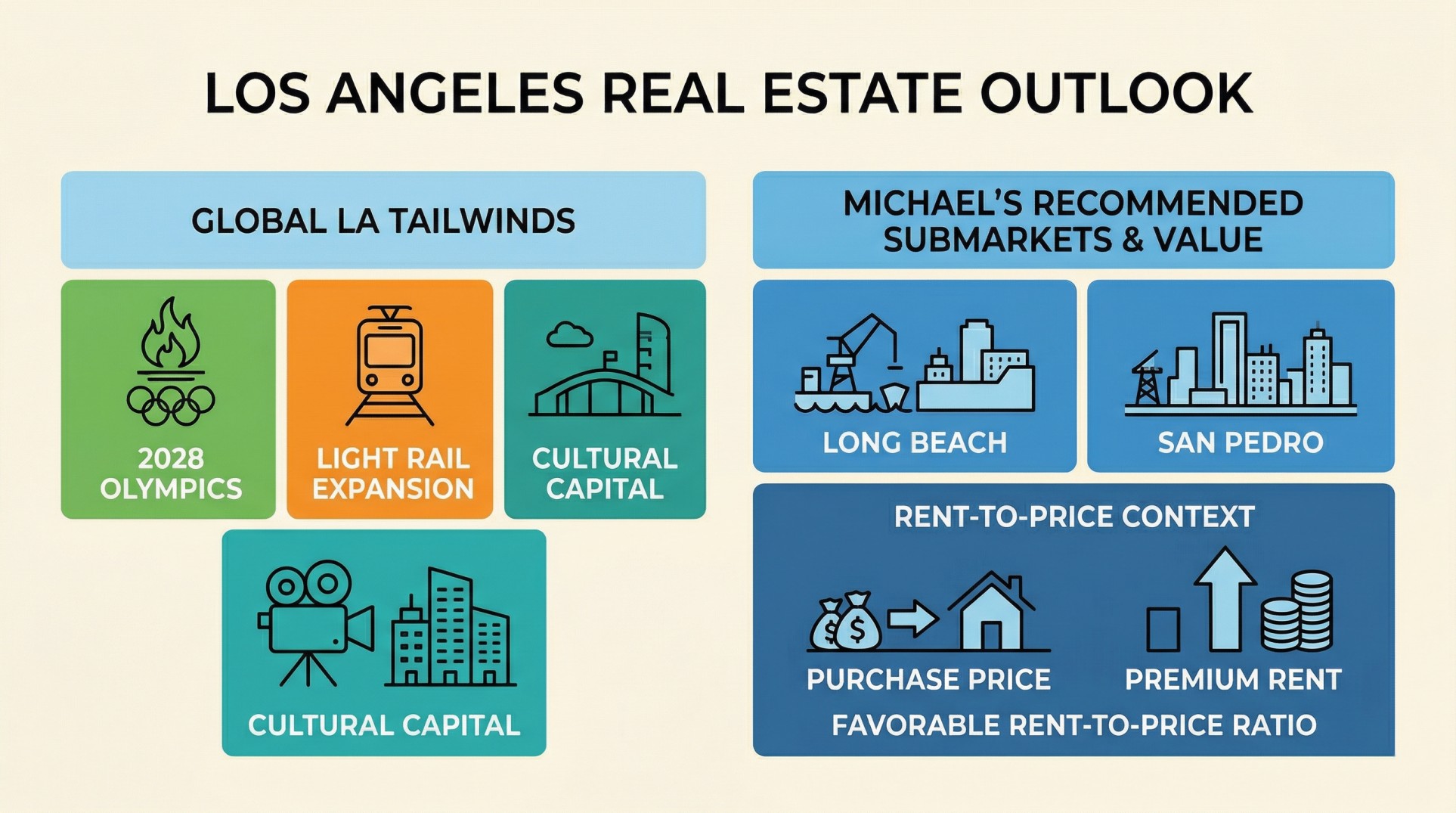
Michael Abraham views real estate as the world’s largest asset class and believes LA will continue to appreciate. The 2028 Olympics are projected to generate over $13 billion in regional economic impact, and light rail expansion is reshaping transit accessibility. He pointed specifically to Long Beach and San Pedro as submarkets where the rent-to-price ratio still works.
“I see LA at an inflection point where it’s going to keep getting better in spite of the politics. If you provide a quality product, people will rent. As the value goes up, refinancing becomes a lucrative way to roll money into other investments. Between the Olympics, the light rail, and cultural projects, I’m a believer in LA in spite of itself.”
The Duplex — Michael’s Top Recommendation for Anyone Living in LA
Duplex investing in Los Angeles is Michael’s clearest recommendation for anyone committed to staying in the city. You offset your mortgage immediately with the second unit’s income, build equity in an appreciating market, and retain flexibility (Airbnb, traditional rental, or guest home depending on your needs).
I have a friend in East LA who Airbnbs her townhome, and it’s a cash flow machine. People constantly visit LA for shows or to escape the cold, and that demand is structural.
Michael also made a point about appreciation math I hadn’t considered. If a home costs a million dollars in LA and $500,000 elsewhere, and both appreciate at 5%, the LA home gains double the equity. The cost to replace a roof is comparable in both.
“It’s not your forever home, but you’re immediately offsetting your mortgage. Live there, make it nice, and use it as a cash-flowing asset later. Real estate typically holds its value. You have to spend money on rent anyway, at least put that toward equity. I’ve done the numbers a million ways on duplex investing in LA and I genuinely can’t find a bad thing about it.”
Passive vs. Active — The Real Passivity Curve of Property Ownership
Michael didn’t sugarcoat this one. Real estate is maybe the least passive investment in the early stages. Once a property is operational, management drops to monthly or annual check-ins. But during renovation and stabilization, you have to show up.
His advice: go to open houses, take pictures, and use Google Lens to find comparable products. Study what sold over asking in your neighborhood and use that as your renovation blueprint. If you don’t like going to Home Depot, hire someone or rethink the strategy. Renovation-based investing creates a job before it creates wealth.
LA’s Housing Policy Problem — Why It’s Harder and More Expensive Than It Has to Be
LA doesn’t facilitate housing of different sizes (dormitory, workforce, townhomes), and entitlement costs can reach $2 million before a shovel hits dirt. Political ads blame investors for housing shortages, which Michael called nonsense.
The “mansion tax” is a misnomer. It applies to properties over $5 million, which in LA frequently means multifamily buildings. And the permitting timeline has become absurd: it took two years to build the Chrysler Building; it now takes two years to get permits in some cities.
Michael summed up the ADU paradox in one sentence. “If you have enough money to build an ADU, you have enough money not to.”
Key Takeaways
Michael Abraham’s “flight to quality” framework targets the best product in a neighborhood. Premium tenants follow premium finishes.
The three seller motivations (speed, certainty, price) offer negotiating leverage beyond the purchase price itself.
Amicable cash buyouts work in rent-controlled markets when they genuinely benefit both parties.
Renovation materials matter more than most investors think. Builder-grade finishes lead to lower rents, damaged units, and doing the work twice.
The LA duplex is the strongest entry point for residents committed to the market, offsetting your mortgage from day one while building equity.
Real estate isn’t passive in the early stages, but once operational, the management burden drops and the wealth engine runs largely on its own.
Frequently Asked Questions
What makes Michael Abraham different from other luxury real estate agents in Los Angeles?
Michael brings a licensed architect’s perspective to every transaction, evaluating properties on spatial quality, design potential, and the renovation path to maximum value. As co-founder of the AMRE Real Estate Group and an agent with Compass in Beverly Hills, he pairs that expertise with a design-driven analytical approach that sets him apart from most practitioners in the market.
What is the “flight to quality” strategy in real estate investing?
Flight to quality targets the best property in a given neighborhood, attracting tenants who over-index in income and want a premium living experience regardless of the area’s overall ranking. This means prioritizing standout finishes, outdoor space, pet-friendly design, and proximity to permanent demand anchors like universities and hospitals.
Is it worth investing in Los Angeles real estate given rent control and high prices?
Michael acknowledges the challenges but argues LA’s structural advantages create consistent long-term appreciation. He cites the 2028 Olympics, light rail infrastructure, and LA’s role as a cultural and entrepreneurial hub. For investors, he recommends focusing on submarkets like Long Beach or San Pedro and using the duplex strategy to offset your mortgage while building equity.
How do you add value to a property in a rent-controlled market?
Target below-market tenants open to amicable cash buyouts, then reposition with quality renovations. Focus on high-impact upgrades (paint, refinished floors, kitchen, bathrooms) and always use materials one step above builder grade. The cap rate math makes even modest rent increases significantly valuable over time.
How can I connect with Michael Abraham for real estate help in Los Angeles?
For luxury real estate in the Los Angeles market, reach Michael Abraham at michaelabraham.realtor or through his Compass profile. He and his team at the AMRE Real Estate Group work across the greater LA market, specializing in luxury sales and multifamily investing. Michael is happy to give time to anyone exploring their real estate options, regardless of whether he ends up directly involved.
Apply to Be a Guest on the Cash Flow Authority Podcast
Michael walked into real estate from architecture and brought a framework most investors don’t have. He’s spent two decades in LA learning to read a building the way most agents read a spreadsheet, and that perspective shaped one of the more practical conversations we’ve had on this show.
If you’ve built your own playbook through hands-on work, whether it’s a deal strategy you’ve pressure-tested, a renovation approach that actually moves the rent needle, or a market thesis grounded in street-level knowledge, we want to hear from you. The best episodes come from practitioners who earned their perspective the hard way.
Disclaimer: The Flow Authority makes no promise or guarantee of any results, money, success, or lifestyle from learning real estate investing strategies. The information provided in this blog is for educational and informational purposes only and should not be considered financial, legal, or professional advice. The views expressed in this blog are those of the author and do not necessarily reflect the official policies or positions of any organization, government agency, or financial institution. Any personal experiences shared are for illustrative purposes only and may not apply to every person's situation. This information is general, not personal. Seek specific advice from a licensed professional for legal, financial, and business decisions. There are no typical results in real estate investing; every person, property, and transaction is unique. The information shared in this blog is believed to be truthful, accurate, legal, moral, and ethical, and is subject to change.