


Alejandro Szita on Self-Employed Mortgages and Scenario-Based Lending | Prosperity Lending Mortgage Broker
Alejandro Szita of Prosperity Lending is the kind of mortgage broker many self-employed borrowers wish they’d met sooner. When I sat down with him on Cash Flow Authority, he didn’t hand me another canned speech about rates or paperwork. He went straight at the real problem: lending scaled by turning judgment into process, and the people who eat that cost are usually the ones building businesses.
This hit home for me. I recently stepped out of W-2 work, and Alejandro made one thing clear: plenty of borrowers can pay, but the system still doesn’t know how to read them.
If you want the longer conversation, including the credit score rant and the practical lending talk most people never hear until a deal is already on life support, the full episode belongs right here.
Where to keep up with Alejandro and Prosperity Lending after the episode:
If you want more from me and the broader Flow Authority world:
From Infomercials to Mortgage Lending — Alejandro’s Unlikely Path

Alejandro didn’t come into lending through the usual staircase of banker, processor, underwriter, broker. He came in through direct-response marketing, where you learn fast whether people believe you and whether your message lands.
“It was by coincidence in a way. I did not used to be in the real estate or mortgage business. I used to be in the advertising and infomercial business with another business partner. We created infomercials. It so happens that one of my best infomercial clients was beginning a mortgage company.”
That background explains why he doesn’t sound like a rate sheet with a pulse. He listens for motive, timing, and leverage. I’ve seen the same thing in how career reinvention actually works, which is part of why Alejandro’s path made immediate sense to me.
Why Self-Employed Borrowers Get Squeezed Out of Traditional Lending
Alejandro put it bluntly, and he was right. Institutional lenders scaled by stripping judgment out of the file. Self-employed borrowers get rejected because their income doesn’t fit the box.
“Lenders, to grow at scale, have stopped thinking. When I’m talking about scale, I’m talking about hundreds of millions or billions of dollars. Just to give you an idea, many years ago, we used to have a lot of loans that we gave to a lender called Homepoint. Homepoint used to do about 700 or 800 loans a day. To get to that kind of volume, you have to create rules and a conveyor belt to do loans.”
His pre-1990s banker example rings true because that model never fully disappeared; it just got reserved for people wealthy enough to buy personal attention. He’s describing a failure I see all the time.
The Credit Score Is Rigged Against Entrepreneurs
The credit section hit hard because a lot of entrepreneurs still treat the score like a moral verdict. Alejandro doesn’t. He treats it like a model with incentives baked into it, and those incentives line up cleanly with how payment history and utilization shape a score.
“The credit score was developed to single out the most profitable borrowers to the creditors. It was not designed to measure success, responsibility, or financial strength. It was designed to capture those people who will be the most profitable to creditors. They came up with arbitrary rules for the calculation of the FICO score based on what they believed would be the best candidate. When you take an employee versus an entrepreneur, the credit decisions are completely opposite.”
He’s right to strip the emotion out of it. I’ve watched investors make smart business decisions that looked ugly to the bureaus for one billing cycle and then spend months paying for the optics. His free score-simulation service matters because it turns the problem into math instead of shame.
Scenario-Based Lending — How Prosperity Lending Starts With the Story, Not the Paperwork
This kind of lending conversation should start with the story, the goal, and the timing. Most lenders start with the portal, the upload list, and the trigger sequence that locks the file before the borrower has even decided what they want to buy.
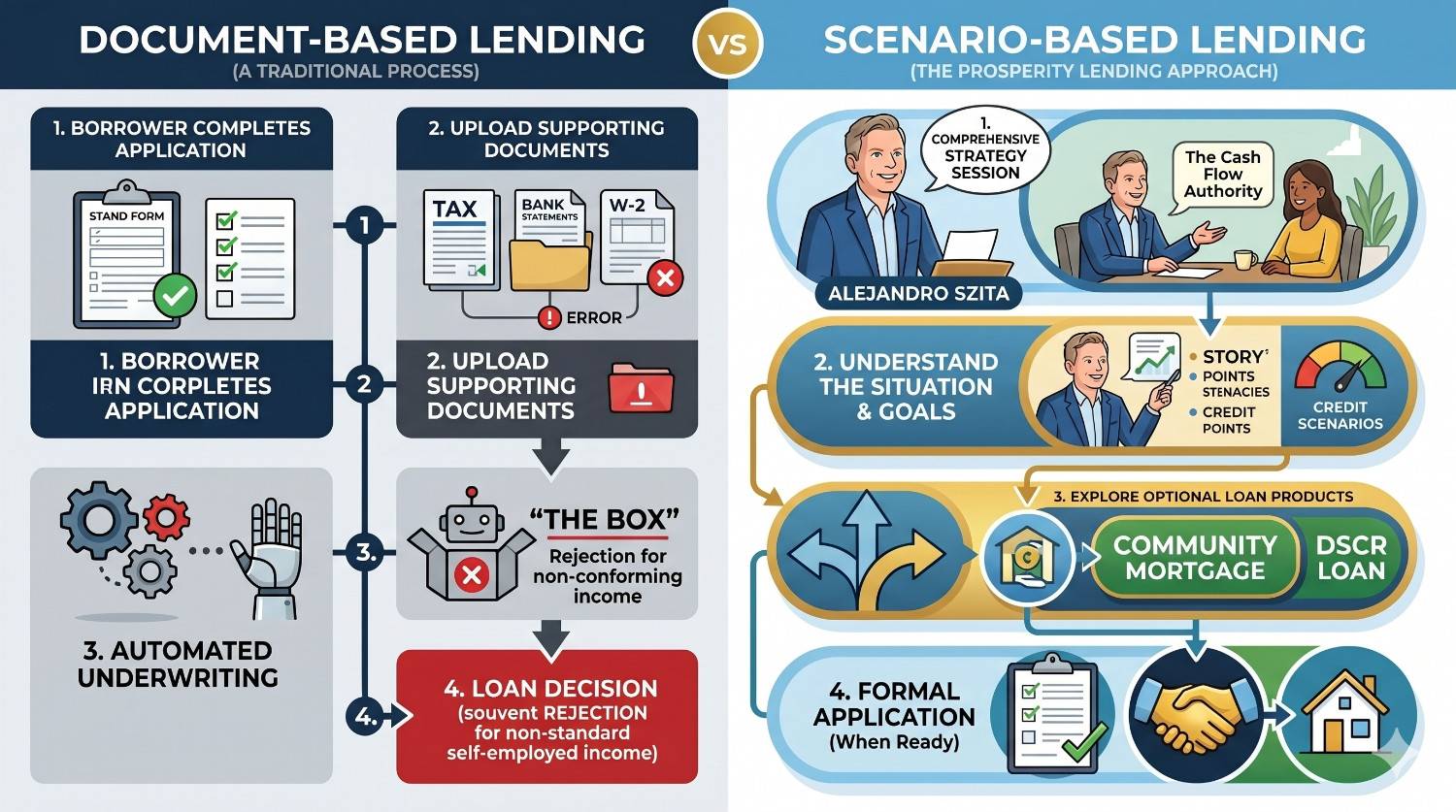
“You can go to my website, ProsperityLending.com. You can send me an email. I have free consultations because for most mortgage shops, the process begins with the application. Our process begins way earlier with a brainstorming consultation. Sometimes our longest customer has been with us for two years before he was ready to apply and buy the home of his dreams. We’re not seeking an application; we’re seeking to establish a relationship.”
That sequence makes far more sense. Start with the conversation, understand the borrower’s situation, and only then decide which loan product fits.
DSCR Loans, Community Mortgages, and the Products Self-Employed Investors Should Know
Once we got into products, the conversation got more useful. DSCR loans sound simple online until a lender asks whether you already own property and have any mortgage history. Alejandro’s point was straightforward: DSCR can solve a real problem, but brand-new investors usually pay for it.
“There is a type of mortgage called the Community Mortgage. A few lenders do it. It doesn’t matter how long you’ve been at your job; all that matters is that you have the down payment and a reasonably good credit score. Your employment history and tax returns don’t matter. This mortgage became available because the government, through the Treasury, created a special window.”
If you’re newly on 1099, that option can buy you time. I covered similar financing tradeoffs in another episode on how investors structure the debt side.
Using HELOCs and Home Equity Without Torpedoing Your Credit
The home-equity portion of this episode felt uncomfortably familiar, which is why it was useful. I’ve used a HELOC for down payments, watched promotional balance transfers tempt me into clever-looking moves, and then watched utilization hit the score anyway.
“You need to have the plan first. You need to have the property that you’re going to invest in and you need to have made your numbers. If you take a home equity loan, whether it’s a HELOC, a second, or a refinance cash out, and you don’t have a clear goal, you end up spending the money and then you end up back at square zero, but now you have this gigantic debt.”
I’ve lived that warning myself. On rental-property HELOCs, he sees limits closer to 70 to 80 percent LTV and still wants strong credit. I wrote more about using leverage only when the next deal is already identified.
Down Payment Thresholds and the Real Cost of Small Loans
Small loans and small differences in down payment don’t stay small for very long. I know that from my own refinance experience, and Alejandro gave the cleanest explanation of the day when he tied it to compliance math and high-cost mortgage thresholds under Regulation Z.
“It’s also because of regulation. If you’re a mortgage broker or lender, you cannot charge more than a certain percentage of costs. As the loan amounts get lower, those small costs become a bigger percentage of the loan amount and trigger compliance thresholds. If you step above 5%, you’re considered a high-cost mortgage, which triggers a bunch of other regulations. 5% of a $100,000 mortgage is $5,000.”
He also made a point more investors should hear early: you don’t need to worship round numbers. If 21.5 percent down gets the payment where it needs to go, use 21.5 percent. Structure matters more than habit here.
Scaling a Portfolio — Partners, Currencies, and When to Actually Buy
The conversation ended in the right place: with the investor, not the loan product. Chris pushed the money-time-knowledge-relationships framework, and Alejandro agreed. I see the same need for structure when I walk newer investors through my 90-day cash-flow framework.
“I wish I could take credit for this answer, but it was given to me by a successful realtor a long time ago. In order for you to buy real estate, many things need to come together at the same time: income, credit score, down payment, and a deal that you can find. Those points only come at certain times in your life, and they aren’t many. When you have a coming together of all those variables, that’s when you should buy because that’s when you are ready. It has nothing to do with the rate or what the government is doing.”
I liked how clean that timing rule was. Buy when income, credit, down payment, and a real deal line up. If one piece is missing, solve for the missing piece or bring in a partner who has it. Rate watching feels productive, but it doesn’t replace readiness.
Key Takeaways
The right lenders won’t sound like script readers. They’ll ask better questions earlier, understand why entrepreneurial cash flow looks strange to institutional underwriting, and know when to route a borrower into a conventional box, a DSCR product, or something more specialized. Alejandro made that case well because he never talked about lending as an abstract system.
That theme kept surfacing through the whole episode: get clear on the scenario before you apply, run the numbers before you tap the HELOC, and choose the product before you chase the rate. Then move when the deal and the borrower are both ready.
Frequently Asked Questions
Can self-employed borrowers still qualify for a conventional mortgage?
Yes. Conventional lending is still on the table if the income is documented the way the lender needs to see it. The problem is usually the file structure, not the borrower’s actual earning power. If the tax returns, bank statements, or profit-and-loss story don’t line up with the box, the loan stalls even when the borrower is financially solid.
What are the DSCR loan requirements for a brand-new investor?
Alejandro’s answer was straightforward: many DSCR lenders want to see that you already own property and have at least a year of mortgage or property history. Some products waive that history, but they usually make up for the added risk with higher cost. That makes DSCR useful, though it is rarely the cheapest path for deal number one.
What if you just left a W-2 job and still want to buy a home?
The Community Mortgage is the product Alejandro called out for newly self-employed borrowers who have good credit and a down payment, even if they don’t have the usual employment history. It ignores the two-year self-employment track record and the tax-return story that shuts many people out. That can keep a good purchase plan alive right after a W-2 exit.
Why does the credit score penalize entrepreneurs so heavily?
Because the system rewards behavior that looks predictable to creditors, even when that behavior has very little to do with real-world capacity. Entrepreneurs tend to use available credit, move capital quickly, and occasionally accept fees as part of doing business. The model reads that as volatility, while a lower-earning employee with cleaner utilization can score better on paper.
What should self-employed borrowers look for in a lender?
What I’d look for first is whether the lender starts with your situation or with their checklist. Prosperity Lending starts with a consultation, listens to the scenario, and then decides which product actually fits. Alejandro also offers credit-score modeling as a free service, which tells you he cares about getting the file right before it ever reaches underwriting.
Apply to Be a Guest on the Cash Flow Authority Podcast
Alejandro brought a clear framework to this conversation. He came in as a lender, but what made the episode useful was the way he translated mortgage strategy back into judgment, product selection, and timing.
If you work in lending, investing, brokerage, tax strategy, insurance, or another part of the business where real decisions get made under pressure, this show has room for you. I’m looking for people who can explain how the work actually gets done, where the systems break, and what professionals should do next when the textbook answer stops helping.