


Chris Miles of Money Ripples on Cash Flow Investing | Cash Flow Authority
On a recent episode of The Cash Flow Authority, I sat down with Chris Miles, founder of Money Ripples, to talk about a subject that gets cleaned up too much online: cash flow. He has built his whole message around a point I agree with more every year. If your plan only works on paper thirty years from now, you don’t have a plan yet.
What made this conversation useful is that we stayed close to the work. We talked through debt versus equity, management, HELOC risk, and why a deal without multiple exits is usually a lesson waiting to get expensive. If you’re serious about how to build passive income with real estate, this is the kind of conversation worth slowing down for.
If you want the full conversation, the whole episode belongs right here.
If you want more from Chris and his world:
If you want more from me and the show:
How Chris Miles Went from Financial Advisor to Cash Flow Crusader

Chris didn’t come into this topic from the outside. He came out of traditional financial advising and decided the standard retirement script was too slow and too disconnected from how people actually want to live. I see the same disconnect all the time with high earners whose money still doesn’t buy enough freedom in the present tense.
That is where his message lands. Cash flow changes the question. You stop asking how large an account might be decades from now and start asking what your assets are doing for you this quarter. It also lines up with the background that shaped how I think about discipline and long-hold investing.
I framed Chris this way when I brought him onto the show:
“Today we’re joined by a special guest, Mr. Chris Miles, who’s very familiar with a lot of these cash flow concepts that we’re going to talk about today and that we like to talk about on the show. He’s the founder of Money Ripples and a cash flow expert himself who helps entrepreneurs build lasting wealth through passive income and financial independence. Chris is a former financial advisor as well and he now focuses on teaching cash flow investing strategies that break away from the traditional retirement models. So, welcome Chris. Really happy to have you today.”
That setup still holds. Chris is arguing for income streams that can carry real weight before retirement age shows up.
The Cash Flow Mindset: Why Income Now Beats Retirement Later
The strongest idea from this episode is simple: cash flow gives you options sooner. That doesn’t mean you ignore appreciation or tax strategy. It means you stop treating current income as a side effect and start treating it as the test.
I also liked where the conversation went once we got into household optimization. A lot of people assume the next move has to be a new purchase. Sometimes the better move is cleaning up the money already leaking out of the system. Chris kept bringing the focus back to structure, and I keep a lot of the education and tools investors can study before they deploy more capital in one place for exactly that reason.
This part of the conversation stuck with me because it gets practical fast:
“You can in some cases restructure a lot of different things so that you might not have to do whatever it is you’re thinking about doing. You can do something simpler or just literally move things around. I love that. I’m not going to pretend I’m an expert at this stuff like you, but I do look all the time at where is my money going and how can I optimize this?”
That is the mindset behind passive income from real estate when it is done well. You tighten the machine until more of your income stays yours.
Debt vs. Equity: Choosing the Right Investment Structure
Debt and equity both belong in the conversation. They solve different problems. Debt usually gives you defined payments and less upside. Equity gives you more participation if the deal performs.
Age and stage matter here. Someone nearing retirement may value predictability over upside because cash flow needs to hit now. Someone earlier in the game may accept more variability if the equity position can compound harder. That is one of the cleaner frameworks for passive income real estate investing.
I asked Chris about that tradeoff directly:
“To me that sounds like more of a debt deal, like a debt investment, right? You’re investing money, like you said, lending money to other investors. There’s also the option of equity. You can partner on deals and join on private equity partnerships. What are your thoughts on that? Does that just depend on your age and where you’re at and how close you are to retirement? Because obviously if you’re retired, then the cash flow is even more important.”
I covered a related angle in a recent breakdown of how lending terms change when DSCR starts driving the conversation. Pick the structure that fits your life.
The Property Management Reality Check
Every investor loves the word passive until a tenant moves out and the punch list starts growing. I use property managers on all but one property, and that exception keeps proving the rule.
The problem is scale. What looks efficient on one property becomes a drag fast when you multiply it. If I am the one handling repairs, turnovers, and tenant calls, I did not buy a passive asset. I bought another job.
That lesson landed on my back before it landed in my brain:
“I’m not a handyman. I hurt my back trying to rip out this tub drain. I’m over here coaching other people like, ‘Don’t do it yourself,’ unless you love it. And even then, if you’re trying to scale a portfolio, your time’s probably better spent elsewhere.”
That is the reality check. Self-management can preserve margin on a small asset. It can also hide the real cost of your time.
Why Geography Matters More Than You Think in Real Estate Investing
Geography changes everything, and I mean that in the blunt, operational sense of vacancy, tenant demand, age of housing stock, and how much management pain each rent dollar can support. My California rental gave me one week of vacancy over two and a half years.
Wisconsin gives me a different equation. The rents are lower. The buildings are older. The management load is heavier. National vacancy data moves in broad bands, but your actual asset decides whether the deal feels passive or feels like a side business with plumbing.
I said it this way on the episode:
“In other parts, it’s kind of wild because I have a lot of investments in Wisconsin and those properties are a lot older so they are a lot more property management intensive. They do more work but then the rents are a lot lower so they’re getting paid less. It’s just interesting. It’s like I can afford to pay them. I wouldn’t want to do it myself for sure even if I was there.”
That Midwest versus coast contrast is also why I keep looking at what makes Milwaukee-style rent-to-price math behave differently from coastal markets. Geography is the operating model.
Unlocking Trapped Equity: Sell, HELOC, or Refinance?
Home equity feels powerful because it is real wealth sitting on the balance sheet. The trouble starts when people treat all access methods as interchangeable. Selling comes with friction. Refinancing has to justify the rate. A HELOC can give you flexibility, but flexibility is not the same thing as safety.
The paperwork matters more than the marketing because a HELOC can carry a variable rate and lender-controlled changes to available credit. It is a tool with terms, and the terms can move while you are using it.
I spelled out that risk on the show after hearing Chris’s warning:
“I’ve used the principles, the concepts of velocity banking before. I don’t think I did it in a truly, like you said, I did take out a home equity line of credit. I used it on two different rental properties actually. I’ve used that flow of money velocity banking strategy to keep the balance down. I’ve reused it before, but I use it more as a flex fund.”
That flexibility is real. So is the downside if you overestimate how permanent the line will be.
Velocity Banking — Is It Worth the Risk?
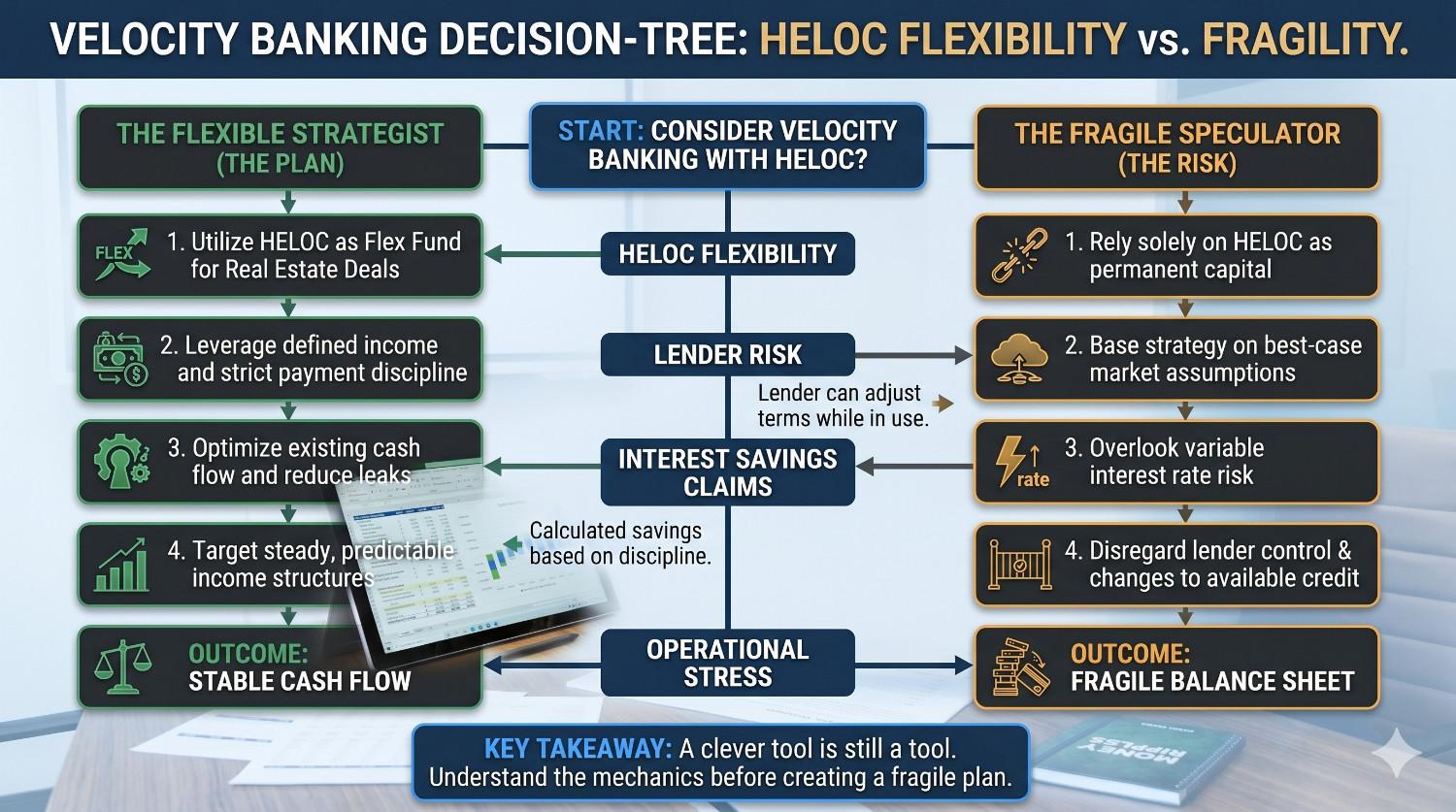
Velocity banking gets sold online with a little too much swagger for my taste. I have used that kind of structure as a flex fund. I have also seen how fast that conversation turns into amateur-hour finance.
That is the right lens for anyone asking how to invest in real estate for passive income without creating a fragile personal balance sheet. A clever tool is still a tool. If market conditions change or the lender gets more conservative, the entire strategy can tighten on you fast.
My own caution came through clearly in this stretch:
“It is really interesting looking at how can you get creative, how can you use different financial tools, infinite banking, velocity banking, all these different concepts. It’s really cool and there’s a lot out there. But like you said, you got to be careful. I’ve heard mixed reviews on the whole velocity banking concept. So, it sounds like you’re against that.”
My takeaway is straightforward. Use it if you understand the moving parts cold. Avoid it if the whole plan depends on best-case assumptions.
The Three Exit Strategy Rule I Learned the Hard Way
This section hits close to home because I learned it with real money. A single strategy can look airtight right up until the market changes or execution slips. Then the same deal starts draining cash and patience at the same time.
That is why I keep coming back to three exits. I want to know what happens if the original plan works, what happens if I need to hold longer, and what happens if I need to pivot quickly. If I don’t like option B or C on paper, I probably shouldn’t convince myself I will like them under pressure.
This is the line from the episode I wish more investors would sit with:
“I’ve learned the hard way. People have told me before, ‘have three exit strategies minimum,’ and I’m like, ‘Yeah, I’m gonna gamble over here. This is fun.’ That one example didn’t work out for me. So definitely I’ve learned my lesson.”
That lesson is expensive and useful. Every deal looks cleaner before it is tested.
Key Takeaways
What I took from this conversation is that cash flow forces honesty into every part of an investing plan. Chris keeps bringing the conversation back to income, structure, and freedom. Debt and equity both have their place. Geography changes the management burden.
I also came away more convinced that this only stays passive when the systems are real. That means cleaner underwriting, sharper awareness of market-specific operations, and more humility around leverage than social media usually encourages. Chris Miles of Money Ripples is pushing people toward income they can use now, and I respect that because it gets the conversation out of theory and back into life.
Frequently Asked Questions
What is cash flow investing and how does it differ from traditional retirement planning?
Cash flow investing focuses on assets that produce income now, not someday. In this episode, that meant looking at real estate through the lens of monthly usefulness instead of distant account balances. Traditional retirement planning still has a place, but it often asks people to wait decades.
Should I choose debt or equity real estate investments?
The better question is what job the investment needs to do. Debt can fit investors who want steadier payouts, especially if they are closer to retirement. Equity can make more sense when you have a longer runway and patience for uneven outcomes.
Is velocity banking a good strategy for real estate investors?
It can be useful, but only when the person using it understands the mechanics. A HELOC can create flexibility across deals, and I have used it that way. The risk is that people start treating the line like permanent cheap capital when the lender controls the rules.
How important is property management for scaling a real estate portfolio?
It becomes important faster than most investors expect. One unit can trick you into thinking you have built a smooth system when you have really just absorbed the work personally. Good management costs money, but the right comparison is your manager fee versus your time.
What is Money Ripples and how does Chris Miles help investors?
His platform teaches entrepreneurs and professionals how to think in terms of cash flow instead of delayed retirement promises. His background as a former financial advisor gives weight to the critique because he worked inside the old model before pushing away from it.
How can I connect with Chris Miles?
The cleanest place to start is Money Ripples, where you can learn more about Chris’s philosophy and programs. His social links are listed at the top of this article.
Apply to Be a Guest on the Cash Flow Authority Podcast
This episode worked because Chris Miles brought a framework, not a slogan. We stayed on the real questions: how income changes decision-making, how leverage becomes dangerous when people stop reading the fine print, and why every deal needs fallback positions before the market forces the issue.
If your work lives in that same territory, investing, lending, operations, construction, finance, or any discipline where cash flow and decision quality separate serious operators from spectators, I want to hear from you. The best guests bring field-tested judgment and a clear point of view.